


Saturday, August 7,
1999
|
|
      
|
THE rich cultural heritage of Punjab has been eclipsed and replaced to a large extent by the western way of life, but a majority of the Punjabi painters have been painting the cultural scenario of rural Punjab which has almost withered away. Some even go to the extent of visiting foreign countries, especially England, Canada and America, with an urge to acquaint the people of the West with the culture of Punjab. This way, such painters deviate from the stark reality and fetch handsome money by selling their paintings to foreigners as well as Punjabis settled abroad. It has been observed that visitors to Punjab from the said countries express their keen desire to get a glimpse of the rich culture projected by our painters. But they are left disappointed.
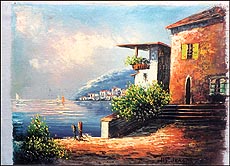
His paintings depicted typical French art and architecture of Paris, the capital city of France, as well as the landscapes of the French countryside. Jnagal especially visited France to fulfil his desire to capture the natural beauty on his canvas. His artistic works on France were also exhibited at Punjabi University, Patiala, and Tagore Vidya Mandir, Ludhiana, where artists and lovers of art assembled in large numbers to assess the uniqueness of his technique. This special technique not only lends enchantment but also imparts a realistic look to his works.
While painting landscapes he strictly abides by the principles of landscape architecture. That is why his paintings of French landscapes are not only charming but also realistic. In the countryside of France he was highly impressed by landscape architecture. He was inspired to take to landscape painting to the maximum possible extent. In the city of Paris his landscapes were admired by Frenchmen. He received series of invitations from famous art societies. On being told that some beautiful ‘Swiss Trails’ have been identified in the Chamba valley of Himachal Pradesh, Jnagal replied promptly that he would have the privilege of painting landscapes of the valley during his next visit. Born in the village of Kala Bara in Ludhiana district, Jnagal is a prominent member of the Victoria Art Society, British Columbia. An ex-army personnel, he is a diploma holder from the J.J. School of Arts, Bombay. After his retirement, he migrated to Canada in 1982, where he took to painting. He had no intention of commercialising it. Besides having acquired specialisation in painting landscapes, Jnagal is also known widely for drawing paintings of the seaside and impressive portraits of nation-builders of India. Jnagal returned to
Canada leaving behind fond memories of his dedication to
the art of painting. His parting message was that the
painters of Punjab should draw the real picture of the
society in which they live. They shouldn’t abandon
contemporary art, he added. |
|||||
 |
 | Good Motoring and You | Dream Analysis | Regional Vignettes | | Fact File | Roots | Crossword | Stamp Quiz | Stamped Impressions | Mail box | |



 Lamenting over such state of affairs in
the Punjabi world of fine arts, Harparkash Singh Jnagal,
a British Columbia-based Punjabi painter, said: "The
culture of Punjab as projected by our painters is far
from reality and such an exercise achieves nothing but
befools and betrays the westerners." During his
recent visit to Chandigarh, Jnagal exhibited his
exquisite paintings in the exhibition hall of the Punjab
Arts Council.
Lamenting over such state of affairs in
the Punjabi world of fine arts, Harparkash Singh Jnagal,
a British Columbia-based Punjabi painter, said: "The
culture of Punjab as projected by our painters is far
from reality and such an exercise achieves nothing but
befools and betrays the westerners." During his
recent visit to Chandigarh, Jnagal exhibited his
exquisite paintings in the exhibition hall of the Punjab
Arts Council.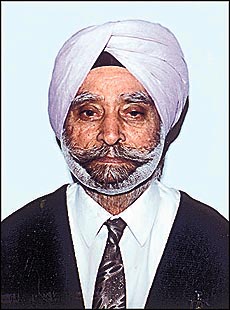 A close observation of the
technique revealed that while strictly adhering to the
20th-century concepts of painting, Jnagal no longer
considers brushes and other traditional tools, including
fingers, essential for use in the application of colour.
He conveys the radiance of colour with paint. For this he
uses various devices for spraying. Especially used
exclusively by him to mix paint on the palette is a
palette knife. Besides tempera, frescos and oil, he uses
three main colouring materials to impart shine and
glamour to his works of art.
A close observation of the
technique revealed that while strictly adhering to the
20th-century concepts of painting, Jnagal no longer
considers brushes and other traditional tools, including
fingers, essential for use in the application of colour.
He conveys the radiance of colour with paint. For this he
uses various devices for spraying. Especially used
exclusively by him to mix paint on the palette is a
palette knife. Besides tempera, frescos and oil, he uses
three main colouring materials to impart shine and
glamour to his works of art.