


Saturday, March 13,
1999
|
|
       
|
WHILE snowfall is becoming increasingly elusive during winters, devastating fires have been breaking out in the Queen of Hills — Shimla — with unfailing regularity, devouring one historic building after another.
The aesthetically designed timber-framed constructions with pitched roofs, gables and chimney stacks blended well with the hill environment. The magnificent buildings dotting the thickly wooded slopes, stood out as fine specimens of colonial architecture. Alas, many of the symbols of imperial grandeur have already met a fiery end. In all about 70 important buildings have been destroyed so far. A few, which escaped the fury of the fire god, have been lost in the concrete jungle that Shimla has become today. Ironically, Kennedy House, the first permanent structure built in 1819 which started the transformation of little known hamlet Shymala into Simla, has also been consumed by fire. The elegant "Peterhoff" building which was a fine specimen of wooden architecture, Harcot Butler school, known for its unique design and ornate woodwork, Wildflower Hall, Himachal Dham, Kinnaur House, Armsdale, Snowdon Hospital, Himachal Pradesh University, Club Lodge of the United Services Club, Regal cinema, Himani restaurant, Nagina building, General Post Office, Ripon Hospital and Anaaj Mandi are some of the buildings that have been gutted in recurring fires. They have been replaced by modern concrete monsters. Some other structures like the Western Command building, at present housing the Army Training Command, were also ravaged by fires. Unlike other buildings it was not standing on a timber frame but had been constructed with iron and wrought iron girders, which survived the fire, enabling the authorities to rebuild the burnt portion as per original design. The building of the Deputy Commissioner’s office, with heavy stone masonry work, too, withstood the fire and was restored to its original glory. The fire god kept its date with Shimla this winter too and as usual struck at midnight, reducing the 97-year-old Walker Hospital into ashes. As it was a wooden structure, the blaze spread quickly, leaving little to control the fire. The entire building was engulfed in flames as the thick coating of paint made the wood all the more inflammable. Everything was over within minutes. It has been the same story all along. When ‘Peterhoff’ the Governor’s House was burnt, the incumbent Governor, Aminuddin Ahmed Khan, could barely manage to come out of the blazing building. He lost all his personal belongings like furniture, jewellery, clothes and was left with only the nightsuit he was wearing. Experience has shown that in case of wooden structures only preventive measures are effective. Once the fire breaks out little can be done to save them. While most of the important timber-framed buildings have been consumed by fires, a few like the magnificent Bantony Estate, currently housing the police headquarters, Winterfield, Barnes Court and the Municipal library are still standing but one wonders how long will they survive. Besides, some other surviving contemporaries of those departed splendours have been made in stone masonry. Prominent among these are Ellerslie, housing the Secretariat, Viceregal Lodge, Gorton Castle, the Town Hall and the Gaiety Theatre. Until Independence there had been few incidents of fire. While the sprawling Grand Hotel complex was devastated in 1922, ‘Chelsea’ housing the country’s famous convent school went into flames just before Partition. In fact, some incidents towards the close of 19th century made the British authorities aware of the fire hazards and they had indeed constructed some fire-proof structures like the massive headquarters complex. It survived a major blaze in 1980 only because of the fire-resistant features incorporated in its two blocks. While the two top storeys which were added later and lacked these features, were destroyed, the rest of the building virtually escaped undamaged. Most of the important buildings gutted during the past three decades were remarkable for their architectural beauty and excellent workmanship. These structures were symbols of the rich architectural heritage bequeathed by the British and reflected a blend of European and indigenous style which was the hallmark of 19th century constructions in the hill-township. The buildings were mostly in Dhajji-style in which timber framed walls were closely packed with stones and compact mud. The ornamental patterns created for the timber framing and typical designing of roofs in Gothic style lent a unique charm to these structures. For instance, the HarcotButler School building with a plethora of pointed arches, which formed the roof, was a unique specimen of wooden architecture. Similarly, the elegant ‘Peterhoff" which perished in 1981, was famous for its intricate and artistic woodwork. The first major fire after Independence occurred in 1956 when the Himachal Dham, housing the state Secretariat, was razed to ground. The current decade has also had its share of devastating fires which claimed several important structures like the Jankidas and some building on the Mall housing the biggest department store of the town, Wildflower Hall, Western Command (for the third time) and the Bishop Cotton School, Asia’s oldest public school. This winter too, the Walker Hospital, one of the few surviving relics of the Raj days, fell victim to the unrelenting fire god. Mercifully, a few shining examples of timber-framed structures are still intact. The imposing ‘Bantony’, housing the police headquarters, Barnes Court, currently the Governor’s residence, ‘Winterfield’, overlooking the railway yard, and the Municipal library on the Ridge, are the most conspicuous buildings which provide a glimpse of the past architectural grandeur. Some of these buildings are reminiscent of countryside cottages of London. Besides, a number of architectural beauties like the ‘Ellerslie’, Gorton Castle, Town Hall, Viceregal Lodge, Gaiety Theatre and St. Michael’s Cathedral, all built in stone masonry, are still there in all their pristine glory. Their survival will
largely depend on the will of the authorities to
implement the fire-safety measures. If the past
experience is any indication the administration has been
lax in enforcing the Fire Safety Act. The fact that the
Jankidas department store and the Western Command
buildings have been devastated more than once within a
decade makes it evident that the authorities as well as
the residents have been negligent in taking precautionary
measures. |
|||||
 |
 | Chandigarh Heartbeat | Good Motoring and You | Dream Analysis | Regional Vignettes | | Fact File | Roots | Crossword | Stamp Quiz | Stamped Impressions | Mail box | |



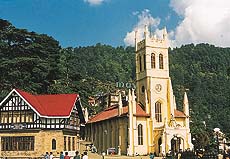 Over the past three decades some of the most
elegant structures of the British era have perished in
mysterious fires. Rarely a winter passes when one or two
buildings are not gutted. Most of the buildings in the
erstwhile summer capital were built of wood. The
indifference of the residents and the administration
towards observing fire-safety measures endangered these
old structures.
Over the past three decades some of the most
elegant structures of the British era have perished in
mysterious fires. Rarely a winter passes when one or two
buildings are not gutted. Most of the buildings in the
erstwhile summer capital were built of wood. The
indifference of the residents and the administration
towards observing fire-safety measures endangered these
old structures.