


Saturday, March 13,
1999
|
|
      
|
FLUTTERING sounds ruffle the serene atmosphere when flocks of waterfowl take a whooping swim before take-off at the sight of human beings in the Hokera Wetlands Reserve here. The entry to the reserve, 10 km north of Srinagar, is restricted. The reserve, which has shrunk from over 13.75 sq. km to about 10 sq. km, holds attraction for thousands of migratory birds from North Polar region during the winter months.
During the last couple of years the number of birds visiting the wetlands has increased. This is believed to be due to two reasons — one because of the lesser movement of people close to the periphery, and due to a decline in the deafening sounds of gunshots that chased away the birds. "Great emphasis is being given to improve protection and extending it to the habitat outside this network", said M.S. Bacha, Wildlife Warden.
Other wetlands in the vicinity of Hokera or Hokersar include Haigam, Mirgund, Narkara, Kranchoo, Shalla-bugh and Kanispora. Except for the reserves at Kanispora and Haigam, near the Wular lake in north Kashmir, which have not been properly cared for due to paucity of funds, all other wetlands near Hokera provide temporary shelter for the birds. On December 6, 1997, for the first time since militancy erupted in the valley, over a decade back, the Hokera Wetlands Reserve was thrown open for shooting birds. In 1990 state government had banned the killing of birds, especially in the wetlands. 'The valley’s
wetlands, both protected and otherwise, face a series of
insidious problems like increased siltation,
eutrophication, peripheral encroachment of farmland,
willow plantations and decreased open water expanse by
reed-bed colonisation", comments M.S. Bacha,
Wildlife Warden. The department has to tackle various
issues and problems faced by the wetlands to provide a
serene and congenial atmosphere for migratory birds.
These include a check on encroachments and grazing around
the unfenced wetlands, regulation of water level and
checking siltation caused by the Doodganga Nullah. The
Doodganga Nullah which drains flood waters from the
Jhelum in Srinagar, poses a greater threat to the
wetlands at Hokersar because of siltation. A project
report had been submitted last year to the Central
government for remedial measures. But no action has been
taken so far. |
|||||
 |
 | Good Motoring and You | Dream Analysis | Regional Vignettes | | Fact File | Roots | Crossword | Stamp Quiz | Stamped Impressions | Mail box | |



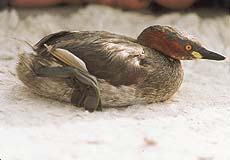 This winter, the staff headed by Ghulam Nabi
Lone, Range Officer at Hokera, had a tough job on their
hands. The prolonged dry spell with temperature going
much below 0°C in December led to a frozen water
surface. "We had to break the ice at different beats
every morning and provide feed to the waterfowl",
said forester Abdul Qudoos Mir, heading the watch and
ward and feeding operations. This practice continued for
about three weeks, when the number of birds was estimated
near 80,000 in the first fortnight of January. A census
conducted in the last week of January estimated a record
number of 1.50 lakh birds. During 1992, their number was
estimated between 25,000 and 30,000. These birds include
greylag goose, ruddy shelduck, pintail, mallard,
white-eyed pochard, red-crusted pochard, shoveller,
brahmni ducks, wigeon, snip and lapwing. There are also
certain local species of birds that have made the
Wetlands their permanent abode. These include the
kingfisher, night heron and garganey. A periodic census
of migratory birds is conducted for scientists and
environmentalists.
This winter, the staff headed by Ghulam Nabi
Lone, Range Officer at Hokera, had a tough job on their
hands. The prolonged dry spell with temperature going
much below 0°C in December led to a frozen water
surface. "We had to break the ice at different beats
every morning and provide feed to the waterfowl",
said forester Abdul Qudoos Mir, heading the watch and
ward and feeding operations. This practice continued for
about three weeks, when the number of birds was estimated
near 80,000 in the first fortnight of January. A census
conducted in the last week of January estimated a record
number of 1.50 lakh birds. During 1992, their number was
estimated between 25,000 and 30,000. These birds include
greylag goose, ruddy shelduck, pintail, mallard,
white-eyed pochard, red-crusted pochard, shoveller,
brahmni ducks, wigeon, snip and lapwing. There are also
certain local species of birds that have made the
Wetlands their permanent abode. These include the
kingfisher, night heron and garganey. A periodic census
of migratory birds is conducted for scientists and
environmentalists.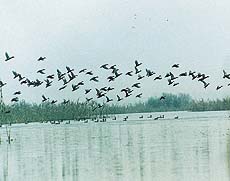 "Most of the migratory birds
use the wetlands in Kashmir as their transitory camps on
their arrival from colder regions between September and
October and on return, later around spring", said
Raashid Naqash, an official of the Wildlife Department.
There are many other wetlands in the valley, where a
number of migratory birds visit during winters.
"Most of the migratory birds
use the wetlands in Kashmir as their transitory camps on
their arrival from colder regions between September and
October and on return, later around spring", said
Raashid Naqash, an official of the Wildlife Department.
There are many other wetlands in the valley, where a
number of migratory birds visit during winters.