


Saturday, May 1,
1999
|
|
       
|
LARGELY due to the human attitude of "neglecting those who bequeath," quite a few earthen dams dotting the Shivaliks, which not long ago hogged media attention for showering prosperity upon the area, are dying...... if not already dead.
Tragically, these "watering holes" of the Shivaliks met their Waterloo due to neglect, lackadaisical approach, apathy and fund scarcity. What looked like jaded jewels in the topography’s crown till yesterday, appear as ugly smallpox scars on the hills’ weather-beaten face today. Spearheaded by a team of scientists from the Central Soil Conservation Institute, under the aegis of ICAR, what started as an innovative experiment from Sukhomajri village in 1978 soon became a concept and was emulated by state governments to ameliorate the economy of other poverty-stricken villages. Overwhelmed by the response that this project elicited, various government and non-government agencies pitched in, rather hastily, to replicate such projects in other semi-hilly villages of Shivaliks. Some worked, others failed, rather miserably. Typically, earthen dams are constructed with earth collected from the upstream side of the probable dam sites. Site selection is important for economising on cost. If a dam site is located on a narrow gorge, it is considered ideal as strong stable sides support the structure. The feasibility also depends on the catchment area, rainfall intensity and discharge. Catchment is the feeding area from where water can be harnessed to reach the dam. If there is a spillway site, preferably a natural, on one side of the chosen site, but at a safe distance from its body, it is considered ideal. Once the dam is constructed by government agencies, it is ultimately handed over to village societies, which act as its guardians. They collect revenue from the beneficiaries. Though the money so earned is just sufficient to maintain a dam, it is not enough for undertaking major repairs. In case of a snag, rural brethren are left with no choice other than to ask the government for funds. Built barely two years ago, the dam at Asranwali, 25 km from Chandigarh, has already started inching towards decay. The dam could provide water to 20 acres of land till a year ago. Today, the water discharge has decreased. "Due to utter neglect, mud has seeped in pipelines and we could irrigate our wheat-sown fields just once, " remarks Ilmdin, a resident of the village.
Dam V in the village standing 12-metre tall has a catchment area of 45 hectares. The spillway broke two years ago. Today, the government after waking up from slumber, has started work on it. Needless to say, the work is moving at a snail’s pace. "Silt deposit has taken its toll. The delivery pipe is choked and we are siphoning off water, " says Somvir, the guard who oversees the dam. Slope of Dam IV has cracked and the underground pipe is choked. Dam VII in the village has the same story to tell. Name of the villages change. But the story remains the same. Five dams were constructed in Chauki village. Only one, constructed two years ago, is in working condition. A dam, constructed in 1984, has eroded. Dams constructed along Landi choe and Bagon nullah are now no more. Many of the dams were "killed" due to the heavy siltation rate, while others were washed away due to improper design and execution. And there are some which did not function due to faulty site selection. While villagers blame the government for not maintaining dams, government officials blame village-level societies, which are usually asked to act as the dam’s guardians, for upkeep of the dams built by them. "Village politics too plays a negative role in some cases," asserts Rajinder, a Haryana government official. Most of the government departments had an evasive attitude on the subject. "We are not the sole government body engaged in repair of faulty dams. The allocation of funds for rectifying a snag-hit dam always depends on what we get from time-to-time," says a Haryana-based Project Director of a World Bank- aided project. "There are around 120 dams dotting the Shivaliks and only 60 per cent of them are in working condition," says Banarsi Das, Principal Chief Conservator of Forests, Haryana. "Sometimes the dams fail due to human error, like bad location or less siltation which does not provide effective bed-sealing to the dam. But, in most cases it is due to the negligent attitude of village societies, which do not care to rectify minor faults, that dams suffer irreparable losses," he laments. "We are not asking for the moon but they can at least provide us with the manpower whenever we require it for repair purposes," he adds. Whatever be the case, land-tillers and villagers are disillusioned and are bearing the brunt of a pass-the-buck policy. They have seen dam after dam crumble and now want to resort to tubewell irrigation. "We tell them that tubewell irrigation is not feasible in hilly tracts due to deep groundwater and undulating topography, but villagers, who have seen the fate of dams, have developed a sort of mental block against such type of irrigation and water storage method," asserts a social scientist connected with the watershed management programme. Officials of the Department of Agriculture, Haryana, say that not always do they "design, build and forget." "We review the case in every problematic village. If the village society has enough money, we ask it to bear the cost of the repairs. Otherwise we pitch in. But that always depends on the availability of funds," says a technical official of the department. He adds that due to such dams, the ground water recharge has been phenomenal. "People on the foot hills have started levelling their fields to dig tubewells because of this," he says. P.R. Khusru, a dam design engineer of the same department, says that it is usually some natural factor beyond human control like heavy rainfall, rather than faulty designing, which causes the demise of a dam. Nature, too has some role to play in this game of "build and break" "Geologically speaking, these hills are of the Pleistocene age and lithologically composed of sedimentary rocks, loose boulders and clay. So, heavy rainfall would always mean heavy erosion, " remarks Dr Naval Kishore Sharma, a faculty member in the Department of Geology. Banwari Lal, one of the executive member of the water users’ society of a village, came out with a novel suggestion. "The government can give some money to the society for repairs when they hand over the charge of the dam." New Centre-sponsored schemes to revive sick dams can also help, he adds. Are the villagers damned
or is their future doomed? While accusations bounce back
and forth like a ping-pong ball, it is the village
economy and farmers who suffer. Balku Ram, a poor
shepherd from Nada village, sits dejected near what used
to be a dam not long ago and pleads to every government
official who visits the site, "Babuji, isda kuch
karo," (Sir, please do something about it). This
sums up an average villager’s desperation. |
|||||
 |
 | Chandigarh Heartbeat | Good Motoring and You | Dream Analysis | Regional Vignettes | | Fact File | Roots | Crossword | Stamp Quiz | Stamped Impressions | Mail box | |



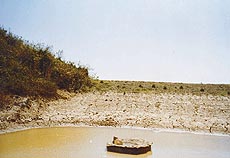 Earthen dams, which form an essential part
of the integrated watershed management programmes, have
proved to be a boon for such villages which had remained
enveloped in the darkness of stark poverty. Not only did
they vitalise rural economy, they rehabilitated the
degraded eco-system as well.
Earthen dams, which form an essential part
of the integrated watershed management programmes, have
proved to be a boon for such villages which had remained
enveloped in the darkness of stark poverty. Not only did
they vitalise rural economy, they rehabilitated the
degraded eco-system as well.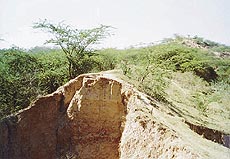 A visit
to Nada village, 10 km from Chandigarh, was an
eye-opener. Dam III at the village is no more. This dam
was the talking point a few years ago as it had
transformed the economy of the village. It is noteworthy
that the dam is located near a Dalit settlement. Today,
the sidewalls have caved in and the depression holding
the water reservoir, which has been taken over by weeds
and wild growth, has become a bucolic lavatory, besides
acting as a grazing ground for cattle.
A visit
to Nada village, 10 km from Chandigarh, was an
eye-opener. Dam III at the village is no more. This dam
was the talking point a few years ago as it had
transformed the economy of the village. It is noteworthy
that the dam is located near a Dalit settlement. Today,
the sidewalls have caved in and the depression holding
the water reservoir, which has been taken over by weeds
and wild growth, has become a bucolic lavatory, besides
acting as a grazing ground for cattle.