


Saturday, October
9, 1999
|
|
      
|
IF you wanted a fancy car in the mid-80s you would have to satisfy yourself with a Fiat or an Ambassador, with usually no added frills and accessories. Then came the car revolution — Maruti 800s, Esteems, Cielos, Sumos and Zens, and more recently, Santros and Mercedes cruising down the streets. This almost sudden boom in the auto industry has resulted in the component manufacturers also incorporating the latest technologies. For instance, the old-time batteries are giving way to the latest state-of the-art batteries that require virtually no maintenance. Some tyre manufacturers have come up with world-class tyres like tubeless, puncture-free, balloon-type tyres and even rally tyres. The electrical component industry offers halogen bulbs, controls, panel meters, thermostats, defrosters, alternators, electrical ignition systems, automatic controlling devices, central-locking system and anti-theft devices, etc. Most engine compoments being manufactured in the country are world-class. Many of these technologies have already been installed in some of the new luxury cars that hit the market.
"Till very recently, components like ACs were being imported, but in the last few years, this industry has also made a big leap and most of the interiors are now manufactured in India," says Prakshit Sood, owner of Sai Auto Industries. "Only for the past 3-4 years, has there been a real demand for interiors. These usually include things like seat covers, stereos, ACs, clinometers (displays wheel pressure) halogen lamps and of late and very popular, central locking system and anti-theft systems (Rs 2500 to Rs 4000)," says Prakshit. "In this day and age it is necessary to instal these systems. The car can be locked/unlocked only with a remote control device which is unique to each car," explains Pawan Ahuja, proprietor of Auto Centre. But apart from these ‘conservative’ demands, there seems to be emerging a market for slightly lavish interiors. "We do sometimes get demands for refrigerators and televisions but they are not so easily available. A 4-inch National TV set costs around Rs 2200 and you can only see Doordarshan on it," says Sanjay Sharma of Sai Kar Nikhar. "But there is an option to attach a regular VCP and even watch a movie. The car fridges are no bigger than 1½ feet but these can be very costly so they are not really in demand," he opines. Incidentally, out of the six luxury Hyundai models on display at the last Auto-Expo, two of them had televisions already installed in them. But there has been a clear shift from the gaudy interiors to a more sophisticated choice, says Prakshit Sood. "I have been in this business for a long time and over the years I have seen the emphasis shift from beading and jazzy stickers, loud horns and distasteful interiors to a more sophisticated look. People are opting for wooden finish accessories and simple upholstery that gives it a personal touch. Also, we must realise that many models of Esteem, Cielo, Zen or Maruti 800 deluxe already have some basic features like AC, upholstery, stereos, etc. Chandigarh has largely a service class but in other cities like Delhi, people do tend to spend far more." But that is not to say that Chandigarh residents are not spending on their wheels. "I just bought a Zen and I have installed central locking, a 500 watts Pioneer stereo system, defrosters, power windows and special lights instead of the usual headlights. Altogether this has cost me about Rs 25,000," says 24-year-old Nitin Chopra, a businessman. It can cost anywhere from Rs 10,000 to Rs 80,000 to customise a car and it is usually the younger people who seem to be indulging themselves by spending so much on their cars. "It is mostly the college, school students and business men who seem to spend so much. They save up and try to outdo each other," says a car salesman. "The accessories I choose to instal in my car is a personal signature. Most of my friends own a Cielo or a Zen. I own a Maruti 800, so to deck it up a bit, I decided to put in rexine upholstery, a music system and I am saving up to instal power windows," says 19-year-old Manish Kalra, a college student. So what makes people go in for these extravagant gizmos? The exposure in the past few years has to a qualitative extent influenced the avid car lovers. This includes the auto magazines, entry of new and flashy cars, satellite television and not surprisingly, Hollywood stars, namely, James Bond and his BMW, fitted with state-of-the-art contraptions. "Almost everyone owns a car nowadays. And people also have more spending money. This permits them to indulge a little more in their cars," says Prakshit Sood. Undoubtedly, we can
expect to see more innovations and equipments in the near
future, making cars self-sufficient luxuries. |
|||||
 |
 | Good Motoring and You | Dream Analysis | Regional Vignettes | | Fact File | Roots | Crossword | Stamp Quiz | Stamped Impressions | Mail box | |



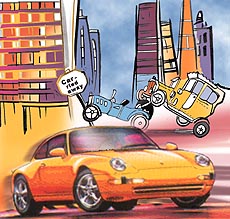 Undoubtedly, a boom in the auto industry
also means a boom in the sale of car accessories.
However, it is no longer only a question of just owning a
fancy car but also what goes inside it. It is about
attitude and status symbol, seldom necessity or
convenience. The complete plush interiors of some new
cars are indigenous and very impressive. Yet, the demand
for special customised features ranging from small
refrigerators to even faxes and television sets is fast
becoming customary. The list of accessories already
available in the market is quite exciting — ACs,
heaters, perfumes and watches (ranging from Rs 100 to Rs
800), 6 to 12-track CD players, television, designer
hub-caps and rear-view mirrors, stereos equipped with
graphic equalisers (Rs 15,000 to Rs 80,000), fancy and
expensive upholstery, fog lights, compass and so on.
Undoubtedly, a boom in the auto industry
also means a boom in the sale of car accessories.
However, it is no longer only a question of just owning a
fancy car but also what goes inside it. It is about
attitude and status symbol, seldom necessity or
convenience. The complete plush interiors of some new
cars are indigenous and very impressive. Yet, the demand
for special customised features ranging from small
refrigerators to even faxes and television sets is fast
becoming customary. The list of accessories already
available in the market is quite exciting — ACs,
heaters, perfumes and watches (ranging from Rs 100 to Rs
800), 6 to 12-track CD players, television, designer
hub-caps and rear-view mirrors, stereos equipped with
graphic equalisers (Rs 15,000 to Rs 80,000), fancy and
expensive upholstery, fog lights, compass and so on.