


Saturday, October
16, 1999
|
|
      
|
BY leading the National Democratic Alliance to a clear election verdict — the first after 1984 — Atal Behari Vajpayee has perhaps equalled the performance of Indira Gandhi, who, like Vajpayee, in the face of heavy odds, led the Congress to triumph in 1971. The elections of 1971 and 1999 thus stand out as highwater marks in India’s political history. In 1971, Indira Gandhi had faced the challenge from what was then called the "Grand Alliance". She entered into electoral adjustments with her party, contesting 441 of the 518 Lok Sabha seats and defeated the first-ever combined anti-Congress onslaught. This time the roles were reversed. While the NDA cannot be called a successor of the Grand Alliance of 1971, the roots of anti-Congress unity, which were established then, have provided a strong basis for the verdict of 1999. In the intervening three decades, the Congress has withered. The BJP, a successor to 1971 Grand Alliance’s Jana Sangh, has grown from strength to strength in this period. Alliances have strengthened the BJP. Almost axiomatically, lack of alliances have led to attrition in Congress’ standing.
The leaders of the BJP have effectively drawn political mileage from the diversity of India. The NDA has regional parties as its constituents. The Janata Dal (United) is the only party apart from the BJP in the new ruling alliance which has pretensions of being a "national party". The JD(U) is at best a multi-state party, with its areas of influence confined mainly to Bihar and Karnataka. (How-ever, being the present-day successor of the dominant faction of the erstwhile Janata Party, sans the "Sangh" elements, it has to be accorded the "national" nomenclature.) All other constituents are essentially regional parties or confined to one state. And all these parties, including West Bengal’s Trinamool Congress, have an anti-Congress identity. The political map of India today reflects the country’s intrinsic strength — its diversity. The BJP while being the ruling party at the Centre has its state governments only in Gujarat, Uttar Pradesh and Himachal Pradesh. The Congress, which till recently was confined to an equal number of states, is now the ruling party in Karnataka, Arunachal Pradesh, Nagaland, Delhi, Madhya Pradesh, Rajasthan, Orissa and Goa. The CPI(M) shares power with its Left allies in West Bengal, Kerala and Tripura while Tamil Nadu, Andhra Pradesh, Haryana, Punjab, Jammu and Kashmir, Assam, Bihar, Sikkim and a host of North-Eastern states are ruled by their respective regional parties. Most of the regional parties have anti-Congress moorings. This was a major reason for friction between the Centre and the states during the Congress rule. Since 1996, with regional parties playing a decisive role in the successive coalitions at the Centre, the rough edges have been blunted. By bringing most of these parties minus the Asom Gana Parishad (AGP) into the NDA fold, the BJP leadership has not only ensured electoral success but also reinforced the fabric of Indian unity. Addressing the first meeting of the newly elected NDA Lok Sabha members in the Central Hall of Parliament on October 10, Atal Behari Vajpayee described the verdict by saying, "India has won". He was perhaps not far from the truth — the composition of the NDA reflects unity of Indian diversity (as distinguished from the cliched slogan, "unity in diversity". Comprising numerous constituents, the coalition called the NDA, from day one is bound to get embroiled in contradictions. It will depend on the statesmanship of Vajpayee and his colleagues in the BJP and partners in the NDA parties to ensure that these contradictions do not flare up into confrontation. On October 10, while addressing the MPs, Vajpayee aptly summed up the situation on the ground by saying, "The definition of dharma holds good for coalitions too. If we protect and sustain the coalition, the coalition will protect and sustain us". * * * The 13th Lok Sabha, like the previous House, will have representatives of 40 political parties. Of these, 16 are NDA partners and one, the Jammu and Kashmir National Conference, has now aligned itself with the ruling coalition. The Congress had not contested the elections in a coalition or as an alliance but by the indirect process of seat adjustments. The "Congress plus" block of 134 MPs has a representation of six parties; the Left Front has five; and 14 parties, including major ones like the Samajwadi Party, the Bahujan Samaj Party and the Nationalist Congress Party, are clubbed under the nomenclature of "others", accounting for 65 seats. The diversity of India is thus reflected in the composition of the House of the People, as the Lok Sabha is described in constitutional parlance. Sometimes there is idealistic talk of need for a two-party system. Those who indulge in this armchair exercise are perhaps oblivious of India’s diversities. A two-party system may have evolved in the USA. Neither Britain nor France nor Germany or, for that matter, most of the constituent states of the European Union, have a two-party system. Most developed nations of the West, as well as the strong democracy in the Land of the Rising Sun, Japan, have multi-party system. In fact coalitions rule most of the European states. Thus the evolution of a successful ruling coalition, as thrown up by results of the elections to the 13th Lok Sabha, augurs well for the Indian democracy. After the failure of the Grand Alliance experiment and the collapse of the Janata Party government, the early eighties saw diverse political formations trying to evolve an alternative to the Congress. The conclave politics, which began with a grand Opposition show hosted by the Telugu Desam led by late N.T. Rama Rao in Hyderabad in 1984, saw regional parties and Left parties holding hands in Opposition conclaves held at Hyderabad, Calcutta and Srinagar. The concept of a "dominant party" for each state forming the core of an anti-Congress alliance was thought of. The BJP, which was "an untouchable" for the conclave leaders who flaunted "secular" credentials, was not included in the Opposition conclaves which had the participation of the Janata Party, the Congress (S), the Left parties, the Telugu Desam, the DMK, the Akali Dal and the Jammu and Kashmir National Conference. The assassination of Indira Gandhi on October 31, 1984, snatched away the plank on which conclave politics had been evolved. The sympathy wave generated by Indira Gandhi’s assassination came as a rude shock to all non-Congress parties. In its isolation, the BJP recorded its all-time low score of two Lok Sabha seats in 1984. The emergence and the failure of the National Front led by V.P. Singh’s Jan Morcha-Janata Dal outfit provided the BJP with the much needed opportunity to shrug off its "untouchable" credentials. The task was difficult because of the acrimony generated due to the Ayodhya imbroglio and the Rath Yatra by L.K. Advani which preceded the events which led to the demolition of the Babri Masjid on December 6, 1992. Today, the Left and the Congress, while opposed to the NDA, stand apart. Most of the regional formations which participated in the conclave politics of the eighties are now aligned with the NDA. What is more, a sizeable chunk of the Janata Dal, including Socialist elements (who, in 1978, had triggered the "dual membership" debate) are today part of the BJP-led alliance. In this evolution, the role of the Rashtriya Swyamsevak Sangh (RSS), the organisational bulwark of the Jana Sangh, and now the BJP, is noteworthy. No doubt the RSS comprises hardliners. However, considering the fact that soon after the election results Vajpayee hosted a meal for K.C. Sudershan, the RSS leader entrusted with the task of coordinating with the BJP, shows that the prudent line adopted by the BJP in order to sustain the NDA is not without the knowledge, if not consent, of the RSS. And here lies the intrinsic strength of the present ruling combination. As long as the BJP does not behave as the Big Brother, nor does it bow down to become a junior partner, the NDA, in its present form, has the possibility of sustaining itself. * * * The all-time low performance of the Indian National Congress is a result of the slow erosion which set in in this premier political party in the aftermath of Indira Gandhi’s assassination. Rajiv Gandhi lacked political experience. Over the past decade-and-a-half, the Congress has been dominated by leaders who have not grown from the grassroots. Oraganisational politics, which brings a political party in touch with the common man, has been replaced by politics of manipulation and opportunism. When the Congress went out of power in 1977, the late Sanjay Gandhi goaded his mother into politics of confrontation. Sanjay Gandhi, whose image was synonymous with the Emergency and its accompanying excesses, became the symbol of protest during Janata Party’s regime. The photograph of Sanjay Gandhi trying to stave off a police lathi during a demonstration by the Youth Congress in New Delhi’s Janpath got etched in the minds of the people. When Indira Gandhi returned to power in 1980, no one questioned Sanjay Gandhi’s locus standi. In fact a fortnight before he perished in an aircrash, the newly elected Congress legislators of Uttar Pradesh had decided on him as the prospective Chief Minister. The death of Sanjay Gandhi saw a reluctant Rajiv Gandhi enter politics. Similarly, a vacuum was created in the Congress hierarchy when Sonia Gandhi turned her face away from politics following her husband’s assassination. The Congress over the past decade-and-a-half has in fact been led by persons who have extra-political outlook while they control the destiny of the world’s oldest democratic political organisation. The inability of the Congress to appreciate the changing times and the need to forge alliances on equal terms (if in Tamil Nadu the AIADMK acted as the Big Brother, so did Ajit Singh’s Lok Dal in western Uttar Pradesh — the faux pas of aligning with Bansi Lal in Haryana has seen the party being wiped out in that state) has been the primary cause for its poor showing in the elections. All, however, is not lost for the Congress. The fact that the Congress could win eight seats in Punjab in a popular election stands out like a ray of hope for the party. Its improved showing in West Bengal, upward swing in Uttar Pradesh, revival in Tamil Nadu and its performance in Karnataka, coupled with the very fact that the doomsday predictors’ talk of the Congress getting less than 100 seats did not come true, shows that all is not lost. In Britain, the Labour
Party was out of power for a decade-and-a-half. That did
not stop it from regaining power last year. If the
Congress concentrates on organisational politics and
moves away from its present anti-coalition posture, it
can emerge as a viable alternative to the NDA. |
|||||
 |
 | Good Motoring and You | Dream Analysis | Regional Vignettes | | Fact File | Roots | Crossword | Stamp Quiz | Stamped Impressions | Mail box | |



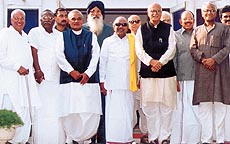 The Jana Sangh was created in the early
fifties as a symbol of protest against the Congress
regime. Just as the credit for uprooting foreign rule
from the soil of India legitimately goes to the Indian
National Congress, the onus of making a serious endeavour
for providing non-Congress rule belongs to the BJP. While
almost all political parties grew out of the Congress
edifice, the Jana Sangh and the BJP have no umbilical
link with the Congress.
The Jana Sangh was created in the early
fifties as a symbol of protest against the Congress
regime. Just as the credit for uprooting foreign rule
from the soil of India legitimately goes to the Indian
National Congress, the onus of making a serious endeavour
for providing non-Congress rule belongs to the BJP. While
almost all political parties grew out of the Congress
edifice, the Jana Sangh and the BJP have no umbilical
link with the Congress.