


Saturday, October
16, 1999
|
|
      
|
KULU is known the world over as the valley of gods. At one time it was the abode of many Hindu sages like the ancient law giver Manu, Vedavyas, Vasistha, Gautam, Jamadagani, Parasar, Vrigu and Ghosa. A part of Peerpanjal range of the Himalayas, the mountains around form the upper basin of the river Beas. It was inhabited by Aryans many millenniums before. Most of them now profess Hindu religion. They are tall, well built, wheatish complexioned, handsome people, generally practicing agriculture, horticulture and animal husbandry. The women folk of the valley, a winsome and charming lot, are extremely industrious, both in house-keeping as well as managing the fields and barns. The men tend to be happy-go-lucky ones. The valley’s children, being chubby and charming, the ‘Kulvis’ — that’s how they like to call themselves — are affectionate people worth knowing individually as well collectively.
It appears difficult to believe but the fact remains that the regime of Kulu gods is like a well-organised medieval kingdom. The people have their family or clan god, their village god, the Phati (group of villages) god and the superior-most lord, the reigning deity, ‘Raghunath ji, located at Raghunathpur, the capital of the erstwhile state of Kulantpith or Kullut — now called Kulu. While the writ of command of these celestial powers descends from Raghunath ji down to the village deities, the prayer move upwards in the same channel. Most (if not all) social and administrative functions of the village society are accordingly performed in the name of and with the blessings of these supernatural powers. Human representation is essential for the supernatural powers also. Accordingly all residents of the area of jurisdiction of a god are supposed to be his servants. The deity has its temple, land, stores etc — all kinds of worldly assets, which also belong the community concerned. The person managing a particular god’s estate is called "Kardar". The individual who interprets and conveys the god’s dictates to the mortals concerned is called Gur. The storekeeper of the god’s property is called ‘Kunjidar’. There can be more of similar assignments and appointments depending upon the quantum of business transacted in the name of the deity concerned. The dependent people take their hardships and disputes like journey, marriage, illness, theft, election etc. to their god, who dispenses the orders in the voice of ‘Gur’. Most of the village matters are thus decided in the village itself. Only a few complicated ones are taken to the usual modern civil and criminal courts.
A student of anthropology, keen on witnessing the actual practice of traditions and customs connected with the Himalayan gods can do so by attending a traditional fair known as Kulu Dasehra. That is the occasion when nearly all gods of the valley gather at Dhalpur maidan, a central large ground and pay their obeisance to Reghunath ji, the chief of them all. It is an annual seven-day fair commencing on the last day of the Dasehra festival as held in the rest of India. It is well known that the whole of India celebrates Ramayana yuga’s Dasehra October every year to commemorate the victory of Lord Rama over Ravana, the demon king of Lanka, and the end of the 14-year exile of the former. More so to commemorate the victory of the virtue over vice. The Kulu Dasehra is, in a way, also celebrated on that every account, but with somewhat different connotations. Kulu state was ruled by Rajput kings during seventeenth century AD. Of them, one Jagat Singh had been enthroned in 1637 AD. Though a god-fearing man himself, he (Jagat Singh) had been misguided by some one to believe that one particular Brahmin among his subjects possessed valuable pearls, which should better be kept in the king’s own treasury. Jagat Singh summoned the Brahmin and told him to deposit the pearls in the state treasury. In fact the poor man had no such pearls and he told the King so. Jagat Singh disbelieved the Brahmin and told him to comply with his orders anyhow or else face serious consequences. Finding no other way out of his predicament the Brahmin gathered his entire family in the house and set it one fire for a collective self-immolation. The Brahmin’s sacrifice left a curse on Jagat Singh, who suffered serious hallucinations. He asked the royal priest-cum-nobleman Kishan Dass for a possible penance. The latter advised the king to obtain ancient Ramayan-era-idols of Lord Rama and Sitaji from Ayodhya, install these in his royal palace in Raghunathpur and worship them most earnestly. Jagat Singh had followed the above counsel in letter and spirit, obtained the holy idols from Ayodhya, installed these in his own palace, declared the idol of Lord Rama as the de-jure-king of Kulu and appointed himself as the pujari (caretaker cum worshipper) of the deity. The penance rejuvenated Jagat Singh’s health. His subjects felt immensely happy over the king’s (also called Thakur in local dialect) rejuvenation, as also his declaration that Raghunathji was the new Thakur.i.e. the king thenceafter. Accordingly, the people of the entire state converged on Kulu, carrying the chariots/palanquins of their respective gods to felicitate Lord Rama’s idol, now addressed as Raghunathji. There being nearly 360 gods in the valley, the process of felicitation, propitiation and jubilation having started on the normal Dasehra (Vijaya Dashmi) day, had continued for a whole week. This celebration has now become an annual traditional ritual. This year it is being celebrated from October 19 to 26. In due course the felicitation of the ‘Thakur’ by the village gods became an annual religious function. It has now become a very attractive Indian festival pulling hoards of visitors, not only from all corners of the Indian subcontinent, but from all over the world. It has all the ingredients of a world class festival comprising display of traditional songs, dances, dramas and cultural items not only of the Himalayan states, but from all parts of the subcontinent. Of late artists, singers, including ghazal exponents, dancing teams from far and near, including foreign countries like Romania, Russia, Europe etc, gather here. The local people come for the Kulu Dasehra festival in their best traditional costumes — though some come in westernised apparel also. They bring the home produce, including a wide variety of fresh as well as dry fruits and cottage industry items like shawls, sweaters, woollen socks and gloves. The traders from plains carry latest fancy and luxury items like electronic good, fabrics etc. The government agencies and NGOs display the latest gadgets, implements and machinery connected with progressive agro-industrial practices. The Kulu Dasehra is thus an event worth seeing at least once, if not every year. Route Kulu and Manali are well-known tourist destinations in the northern India. Direct one-day buses are available from Delhi, Chandigarh, Kalka, Pathankot and Jogindernagar railway stations. Deluxe buses and taxis too are available. The normal route for a motorist is 520 km long route from Delhi via Ambala, Chandigarh, Kiratpur Sahib, Bilaspur, Sundernagar, Mandi, Aut, Bajaura, Bhuntar. It is a good all-weather metalled road — a 14-16 hour drive, with scenic resting places and good rest houses tourism bungalows (rents nominal) en route. For an adventure-loving traveller there are quite a few permutations and combinations, like (i) Shimla, Luhri, Jalori Pass, Aut, Bajura, or (ii) Pathankot, Kangra, Palampur, Baijnath, Jogindernagar, Mandi or (iii) Shimla, Rampur Kaza, Kunzum, Rohtang, Manali etc. The P.W.D. and forest rest house existing all along (at every 10 to 15 km) these routes are a bonus for travellers endowed with good organising acumen. Weather Kulu is located at 4000 feet above sea level and tends to have a very pleasant weather almost throughout the year, except during sudden spells of inclement weather, mostly during winter season. Therefore, carrying woollens is very desirable. Accommodation The Kulu valley has a
large number of hotels, motels, rest houses, guest houses
and inns. While the higher income group visitors can have
costly accommodation, from Rs. 600 upwards for a
double-bed room, the student groups or budget travellers
can make do in dormitories which charge around Rs 50/-
per head. Similarly, for boarding i.e. food, expensive
cuisine restaurants are available as also cheaper meal
"dhabas" serving reasonable good
vegetarian food. Shelter-wise, travellers carrying their
own light-weight mountaineering tents can have quite a
wide choice of the location where to stay. |
|||||
 |
 | Good Motoring and You | Dream Analysis | Regional Vignettes | | Fact File | Roots | Crossword | Stamp Quiz | Stamped Impressions | Mail box | |



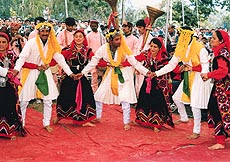 The ‘Kulvis’, themselves
generally being Vashanavite Hindus, are pretty
open-minded about faith and religiosity — a really
happy seculiaristic psyche. Traditionally they enjoy
complete faith in their gods. They respect other
religions also open-heartedly. That is why people
professing other different religions like Buddhism,
Sikhism, Christianity etc., are happily flourishing in
the valley — though in small numbers.
The ‘Kulvis’, themselves
generally being Vashanavite Hindus, are pretty
open-minded about faith and religiosity — a really
happy seculiaristic psyche. Traditionally they enjoy
complete faith in their gods. They respect other
religions also open-heartedly. That is why people
professing other different religions like Buddhism,
Sikhism, Christianity etc., are happily flourishing in
the valley — though in small numbers.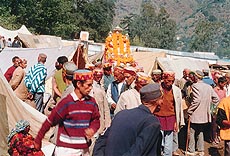 The
ideal time to have a feel about the functioning of the
writ of the Kulu gods is around various elections for
panchayat member (s) or general elections for the Vidhan
Sabha or Parliament. Depending upon the forum for which a
person is to be elected, the deities jointly or severally
decide as to for whom of the candidates will the ‘Kulvis’
vote for. And it is a matter of unwritten record that
a candidate approved by the ‘Devtas’ (deities
of Kulu) invariably win (s) the elections.
The
ideal time to have a feel about the functioning of the
writ of the Kulu gods is around various elections for
panchayat member (s) or general elections for the Vidhan
Sabha or Parliament. Depending upon the forum for which a
person is to be elected, the deities jointly or severally
decide as to for whom of the candidates will the ‘Kulvis’
vote for. And it is a matter of unwritten record that
a candidate approved by the ‘Devtas’ (deities
of Kulu) invariably win (s) the elections.