


Saturday, October
16, 1999
|
|
      
|
WHAT happens when two creative writers are drawn irresistibly towards each other? How does such a relationship influence the individual creativity of the two involved? Does the intellectual aspect dominate such affairs or do the emotional and physical sides play bigger roles?
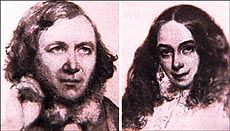
Let us go back to the Victorian era, to the days of the poet Robert Browning. Back in England after a trip to Italy, the 33-year-old Robert comes across a work of poetry by one Elizabeth Barrett, The Geraldine Courtship. With the intention of beginning their own courtship (having so far seen only her words), he writes her a letter in which he appreciates her poetry and articulates his love for her. Elizabeth, left a semi-invalid by a childhood accident, answers in the positive but refuses to see him, fearing the affair would end once he saw her. Nevertheless a persistent Robert manages to draw her out of her solitude and she agrees to meet him and the plot (love) thickens. However, marriage is out of the question, as she is very afraid of her domineering father. Here again he succeeds in getting her consent. A secret ceremony is held and soon the two escape to Paris, finally setting in Florence where they live a happy and creative life and become famous. Phew! A fairy tale? Well, almost, for their good luck did not last very long. Elizabeth’s health gradually failed and she died in 1861, after having borne him a son. A grief-stricken Robert returned to London where he edited her unpublished works and spent most of his later years. He too died in Italy — Venice, 1889 — but his wish of being buried besides his wife in Florence could not be fulfilled.
Hammett, who had already become popular with The Maltese Falcon (1930), was largely responsible for her initial success. When the ambitious Hellman started writing plays, he was the one who typed them. He also gave her the plot idea and made improvements in the text for her first hit, The Children’s Hour. However, his own creativity was affected, partly due to the manipulations of Hellman and partly due to pulmonary disease and hard drinking. As his health deteriorated, his output dwindled. As a communist, he landed in trouble during the McCarthy era (the 50s). Hellman, who was now a celebrity, did not come to his help — fearing it might ruin her own reputation — and fled to Europe. The crest-fallen and humiliated Hammett died in 1961, bringing the more-bitter-less-sweet relationship to a halt. Hellman did not check her scheming ways even after his death, expropriating that half of his estate which he had willed to his daughter. Perhaps the most fruitful of them all was the affair between two of the most influential philosopher-novelists of this century — Jean-Paul Sartre (Being and Nothingness) and Simone de Beauvoir (The Second Sex). Both were hard-core intellectuals who greatly respected each others’ ideas; both hated orthodoxy, religion and the bourgeoise. Most of the time in this relationship, which lasted a staggering 51 years, was spent in comparing, reviewing and adjusting each others’ philosophies. Neither did they marry nor had children, Sartre being against these ‘‘bourgeois practices.’’ They agreed that their affair should be open, where they would support each other in times of need, but also allow each other complete liberty — a Platonic association. Both had their fair share of adventures — each chose multiple partners of either sex — and perhaps they suffered at times because of this mutual freedom. Nevertheless, this great example of friendship and symbiosis managed to brave all storms and grew in strength as the years progressed. During the sixties and the seventies, the two lovers travelled a lot and took good care of each other. It all ended in 1980 — of course, only at a physical level — when Sartre died, with Simone at his bedside. Ted Hughes, the English poet laureate, first met the American poetess Sylvia Plath in a literary party at Cambridge in 1956. Thus began a sizzling romance which was followed by marriage and two children. The publication of his first critical success, The Hawk in the Rain, was largely due to Plath’s initiative and encouragement. However, as Hughes established himself as a major poet, his association with the paranoiac and self-destructive Plath gradually soured. Moody, suicide-prone and jealous, she was ultimately forsaken by him for a married woman named Assia Wevill. She spent that London winter — the coldest of the century — completing her pessimistic masterpiece, Ariel. In February 1963, she made another attempt on her life, her last, a success. Her death was a tragedy
for Hughes, aggravated by the literary world which held
him responsible for it. The subsequent deaths of Assia
and his mother further demoralised him and contributed to
the creation of his most intense and famous work, Crow.
His last book, Birthday Letters, was a poetic
memoir of his relationship with Plath which revealed
that, even after all these years, her memory still
haunted (and pained) him. |
|||||
 |
 | Good Motoring and You | Dream Analysis | Regional Vignettes | | Fact File | Roots | Crossword | Stamp Quiz | Stamped Impressions | Mail box | |



 All these questions, intriguing
indeed, add an interesting dimension to the biographical
probe into the lives and loves of renowned writers.
Literary history luckily provides us with some
fascinating examples involving distinguished pen-friends
which are indeed quite revealing.
All these questions, intriguing
indeed, add an interesting dimension to the biographical
probe into the lives and loves of renowned writers.
Literary history luckily provides us with some
fascinating examples involving distinguished pen-friends
which are indeed quite revealing.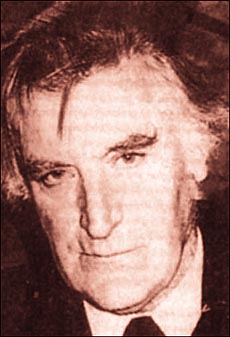 Lillian Hellman, arguably America’s
most important woman playwright (The Little Foxes, The
Children’s Hour) had a very busy love life,
dominated by her affair with one of the masters of
detective fiction, Dashiel Hammett. (The Maltese
Falcon, The Thin Man). Both were talented and
carefree and had a long but uneven affair in which they
liberally granted each other sexual freedom.
Lillian Hellman, arguably America’s
most important woman playwright (The Little Foxes, The
Children’s Hour) had a very busy love life,
dominated by her affair with one of the masters of
detective fiction, Dashiel Hammett. (The Maltese
Falcon, The Thin Man). Both were talented and
carefree and had a long but uneven affair in which they
liberally granted each other sexual freedom.