Saturday, May 22,
1999
|
|
      
|
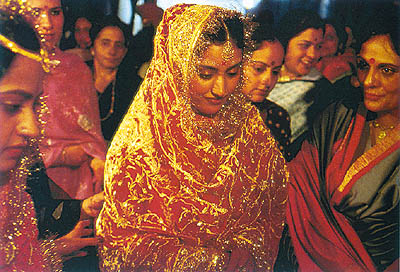
IT was taxi driver Jaswant Singh’s turn to ride in the white stretch limo. Thick gold trim hanging from his hot pink turban framed Jaswant’s face as the 20-year-old groom strolled into the Sikh temple in Richmond Hill, Queens, on Thanksgiving weekend for his arranged marriage to a bride he’d never met. Throughout New York, in communities that still practice arranged marriages-Sikhs, Muslims, Hindus, and Hasidic Jews-young people say they feel good enough about the ancient practice to continue the tradition, albeit in a more "American" way.
At Jaswant’s wedding, his little cousins giggled in awe at the $20 and $100 bills pasted on his multi-strand pearl necklace. On the other side of the family divide, wizened old men in white linen turbans, just arrived from India, joined hundreds of relatives and friends packed into a small temple prayer hall, where they sat on the floor in anticipation of the marriage of their niece, Jasbir Kaur. "I can’t wait to see how beautiful she is," said an eight-year-old girl as she proudly showed her henna-painted hands to a friend. "I wonder where she is," she added. Two hours late, 18-year-old Jasbir finally arrived, shaking and sniffling. All eyes were fixed on her as she sat in the middle of a semicircle beside Jaswant. The two bowed, touched their foreheads to the ground, and agreed to live together for the rest of their lives. "It’s normal that she cries," laughed an elderly uncle. "She is leaving home and her parents for the first time. She is scared, it’s natural." "When we Sikhs marry someone we have barely met," said an earnest newlywed, "we know that the person we are marrying has the same background and goals." Love never lasts, she declared. After Jaswant doffed his gold trim, he and Jasbir circled the Sikh holy book, The Guru Granth Sahib-which is decorated with bright-coloured swirls-four times. An old man whispered that the book is considered almost a "god in itself." Later, in front of the temple, teenagers clad in Tommy Hilfiger shirts, wearing gold earrings and medallion necklaces, talk to a reporter about Sikh tradition. "I will definitely marry whom my parents wish," exclaims Dimpy, an 18-year-old who’s been in the U.S. for half his life. "They know me better than I know myself." Inesha, a 15-year-old American-born girl, goes to a Queens school with few other Sikhs. She hopes to fall in love and choose her own mate, although one her parents would accept: i.e., a highly educated Sikh from the Punjab region. "If I can’t find someone by the time I’m 22 or 23, I will go to my parents for help," she asserts. The kids talk about getting crushes in school, and one girl reveals she actually dated someone she met online. Sikh teenagers cyberflirt in Rediff.com’s chat rooms. Thirteen-year-old AOL addict and rock band member Amrisha has modern parents. Her mother, Rupinder, is a social worker (and, at this temple, a rare career woman). Her father, Hakim, has short hair (Sikh males’ hair is generally uncut from birth). However, they met only once in India before they got married, and speak proudly of the system they take part in. The Sikh religion does not require arranged marriage, Hakim explains. Instead, the custom is rooted in thousands of years of cultural practice. In America, it is nearly impossible to arrange marriages the way it is done back home. In India, families routinely do matchmaking, but many young Sikhs have recently emigrated to the U.S. alone and are living in small isolated enclaves. Some have been relying on the Internet to find partners. Sites such as SuitableMatch.com and INDOlink.com run "matrimonial" ads-rather than personals-for the entire Indian community. The ads are usually placed by parents. Rather than seeing them as a last resort, many look to these ads as a starting place. African American and ethnic Muslims also find themselves in mini crises over their cultures’ arranged-marriage strictures, and have therefore Americanised their system to a degree. "We don’t live with the same intensity of community that they do in Morocco or Egypt," explained Safia, an African American woman who converted to Islam in the ’70s. She was speaking in the women’s prayer room in a small Manhattan mosque as North African women, covered from head to toe, listened intently. "We have to consider people who may come from very far away," she said. "And that poses the problem of not knowing anything firsthand about the other family." Everybody nodded. "But," unlike the Middle Eastern women, who said that they could only marry Arab Muslims, Safia added, "I have no problem mixing with other ethnic groups, because we are all Muslim. And Islam preaches no race preferences." Racism aside, some ethnic American Muslim youth fear a potential culture clash. Nadia, a 20-year-old New York City-reared college student of Bangladeshi descent, said that if she doesn’t find someone in her circle of Muslim friends within a couple of years, her parents will suggest their ideal candidate: a Bangladesh-born Muslim. "But I really hope not," she added, speaking at the Centre for India Studies at Stonybrook, Long Island, "because it’s really hard to relate to each other." Like Sikhism, Islam forbids premarital sex, and therefore American-style dating, according to Sister Raheemah Mohammed of the Masjid Malcolm Shabazz in Harlem. So in traditional Islamic communities, parents assume the responsibility for finding marriage candidates for their offspring, carefully examining the upbringing of the potential match and the reputation of prospective families. But in the Harlem community, members seek their partners on their own. "Arranged marriage is a custom, not an Islamic precept," explained Sister Raheemah. At about age 18, couples begin going on "Islamically acceptable" chaperoned dates, followed by a short engagement period of maybe three months before they are wed, she added. "Allah knows what’s in our hearts. So there’s no need for a long engagement if you are with who you are meant to be with." Imam Omar Abu-Namous of Riveside Drive’s Islamic Centre, says that Muslims of all ethnicities come to him asking for help. He makes announcements about available individuals at religious services from time to time. He says that some marriages have come of it. It’s Thanksgiving weekend for the Patels (a family name as widespread in India as English Smiths or Jewish Cohens). Nearly 3000 members of the prominent Hindu clan have gathered from all over the U.S. in Atlanta for what 20-year-old Anajali Patel calls the "meat market." Seven hundred Patels register as "single." Three hundred matrimonies per year are generated by this event, which is held every year in a different U.S. city, and follow-up mailings, according to Ravi Patel, chairman of the Charotar Patidar Samaj Association, which runs it. The Patels gather for three days of socials, panels, and vegetarian-friendly meals in a high-speed attempt at finding new family members. Anajali, a Queens-born Hindu student at SUNY Stonybrook, has a friend who met her husband at the "market," and knows many other happily married couples who met there. But she hopes never to have to go herself. Unknown to her parents, Anajali dates-but only other Hindus. "I can’t relate to the arranged marriage thing because I grew up here," she says. "I’m used to dating and to bars." She acknowledges that all the "successful" marriages in her family have been arranged. "But I’m too American," she says. Ultimately, she hopes to fall in love with someone who will be accepted by her parents, although she may choose a different path. Professor S. N. Sridhar, director of the Centre for India Studies at SUNY Stonybrook, sees a new marriage model among Hindus: the child-initiated, parent-arranged marriage. "It was after my wife and I decided to get married that our parents ran background checks on the families, and then planned and hosted the wedding," Shridar says. "It’s a common modern Indian compromise." (He says he and his wife rejected the dowry ritual, which they consider objectifying, as do many educated Indians.) According to Sridhar, Hindu law favours arranged marriage, but allows romantic unions. Moreover, romantic love is celebrated in Indian epics and mythology. The classic drama Shakuntalam by Kalidasa, the "Shakespeare of India," is a romantic story about a man and a woman who meet in the woods and fall in love, Sridhar points out. Family values have overridden the notion of romantic love throughout most of Indian society, he adds. "In contrast," in the U.S. "the stress on individuality has encouraged romantic love. "But," he offers, "we can’t forget that although arranged marriages don’t begin with love, they usually end with it." In fact there is a large body of romantic poetry addressing post-marriage love in India. In one poem, by K. S. Narasimhaswamy, a recently wed male meditates: It was only a month since I saw her Love came somehow unseen. Need one have heard or seen or played with the other?... To be suffused with the light of love. The Internet is bringing evil into the house!" proclaimed a Hasidic father at a recent religious gathering. "Our kids are flirting with one another!" Indeed, one newlywed, Leivy, explained to the Voice in a twentysomething Jewish-singles chat room that if it weren’t for AOL, he never would have "fooled around" before he met his wife. Leivy was 23 when he went out on a date alone for the first time "with a Lubavitcher girl that nobody knew." They had set up a date online and once they were out, they realised they could do whatever they wanted without suffering any social consequences. "I feel very guilty now, even though I had a great time," Leivy reflects. Lubavitch is the only Hasidic sect that embraces the Net. Its late leader, Rebbe Menachem Mendel Schneerson, declared that all technology should be used to spread Hasidism among Jews. But Rabbi Kasriel Kastel, program director of the Lubavitch Youth Organisation, maintains that this banter on the Net is only a distraction from youngsters’ "studies and focus." Kastel, who has just launched www.mitmazel.com-which includes a program to help older, modern Jews find marriage partners-asserts that "Lubavitcher kids don’t need to do this." At "the right age," they begin meeting and choosing their future spouses, he explains. "They don’t need these games." Yet, at almost any time in a Jewish chat room, there are likely to be at least a couple of Lubavitcher youths conversing across gender lines-and not necessarily only with other members of the sect. Some of this cybersurfing has led to matrimony. Moshe, for example, was lonely in England before a friend recommended that he hook up online. Within a week, he found a Lubavitcher girl in Los Angeles. They married a short time later. Menachem-"Niceboy," as he signs himself on AOL-is still seeking a wife in cyberspace. He grew up in Brooklyn, and is now 24. Time to marry is running out-Lubavitch males are expected to be wed by their mid twenties-and Menachem has been having trouble finding a mate. His rabbi recommended the Internet. "Chat rooms are beginning to change the social order," observes one 26-year-old college-educated Hasid. Boys and girls are arranging their own dates and marriages. They finally have a socially safe way to get to know one another. Traditionally, in Crown Heights, professional shadchen (matchmakers) organise meticulous index files containing photos, educational backgrounds, family information, and medical histories of marriage-aged prospects. Parents set up in-house, supervised dates. If all goes well, a pair ventures out on their own to a public place like South Street Seaport or Central Park. Couples date on average two weeks to three months before an engagement is announced. (In other Hasidic sects, couples meet only once before they marry.) "Getting matched up is becoming ‘in’ now," says Lubavitcher Pearl Lebovic of the matchmaker centre Likrat Shiduch (Toward the Match), which serves Jews of all sects. Lebobic and her husband Rabbi Yeheskel Lebovic have been connecting young people since 1981. "Details get in the way," she emphasises. It’s the demeanour, or the "feeling they give off," that she clearly remembers in every person she interviews. Her service is responsible for approximately three to four engagements per month. "The system isn’t perfect, and it doesn’t work for everyone," says a recently wed Lubavitch woman, referring to the exposure of abuse that has emerged in documentaries about arranged marriages. "But this is the system we know and trust, the way we couple, and the way we learn to love. "So it works for most of us." (Downloaded
from the Internet) |
|||||
 |
 | Good Motoring and You | Dream Analysis | Regional Vignettes | | Fact File | Roots | Crossword | Stamp Quiz | Stamped Impressions | Mail box | |