

Thursday, April 29, 1999
|
N A T I O N |
|
| weather n
spotlight today's calendar |
 |
 |
|
|
Power game has hit economy: PM NEW DELHI, April 28 — The Prime Minister, Mr Atal Behari Vajpayee, today chose a meeting of the Confederation of Indian Industry to set the election campaign rolling with a stinging attack on the Opposition for causing unnecessary turmoil in the country. |
 |
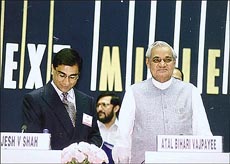 Prime Minister Atal Behari Vajpayee at the national conference and annual session of the CII in the Capital on Wednesday. Outgoing CII President Rajesh Shah is seen on the left. — Photo by Vijender Tyagi.
|
|
Awards for two Indian scientists NEW DELHI, April 28 — B. Sriram Shastry of the Indian Institute of Science in Bangalore and Biman Bagchi of Calcutta are among the scientists who are to receive the Third World Academy of Sciences awards in basic sciences for 1998, the academy announced today. Boiled water
‘lessens’ risk of jaundice
PCS
rules: SC directive on retirement Fodder
scam accused found dead in jail Panel
to study water problem CII
executive's mother found murdered |
||||||
 |
|||||||
Power game has hit economy: PM NEW DELHI, April 28 — The Prime Minister, Mr Atal Behari Vajpayee, today chose a meeting of the Confederation of Indian Industry (CII) to set the election campaign rolling with a stinging attack on the Opposition for causing unnecessary turmoil in the country. 'The country has journeyed through a period of unavoidable and unnecessary turmoil in the past few weeks. Irresponsible and unprincipled politics has played tricks with the people’s mandate', Mr Vajpayee told the inaugural session of the annual conference of the CII here. In a 15-minute address, which was telecast live by Doordarshan, a rejuvenated Mr Vajpayee showed glimpses of his celebrated oratorial skills, saying that in his four decades of parliamentary life he had never transgressed the tenets of democratic conduct while in the Opposition. "I would not have minded if, those who wanted our Government to go, were able to put together a stable, viable alternative. Alas, the country could not get any kind of alternative government." The Prime Minister said the worst victim of this power game, which had pushed the country into a third general election in three years, has been the economy and India’s image abroad. While the loss suffered by the country was measurable and intangible, the costliest loss was the loss of time, since time was the most precious of all resources. Mr Vajpayee also utilised the occasion to appeal to the people to give him a full mandate. Like bad politics was the worst enemy of the economy and business, similarly the best friend of the economy and business was good governance, he said. 'The coming elections, whenever they are held, are thus an opportunity for our people to give a full mandate to those wedded to faster economic growth and a firm and fair administration', he added. He recalled his address to the CII meeting last year, saying at that time 'I had wondered whether doing so comes with a price tag'. He was referring to the fact that three different Prime Ministers had inaugurated the previous three annual conferences of the CII. 'But as you can see, I am here before you for the second time. I can assure you that, with the support of the people of India, I shall be with you next year, too, for the third consecutive year', he said amidst a standing ovation from the audience, which consisted of captains of Indian industry, diplomats and senior economists. 'I have full faith in the maturity of the electorate to give a full mandate to that alliance of the parties , which has demonstrated it faith in reforms — not through words but through decisive action', he said. Highlighting the major policy decisions that was taken during the last 13 months, Mr Vajpayee said that the government gave a "new impetus to agriculture, infrastructure, financial sector, foreign investment, exports , telecommunications and information technology". The country held high despite attempts to isolate and browbeat in the wake of the nuclear blasts, Mr Vajpayee said referring to the economic sanctions. "If Pokhran strengthened our national security, the bus journey to Pakistan was a sincere attempt to bring in a new era of peace and cooperation in South Asia", he said, adding that the free-trade agreement with Sri Lanka, renewal of the transit treaty with Nepal and improvement of bilateral relations with Nepal were also a part of the same endeavour. Complimenting the companies that had done well during a difficult year, the Prime Minister said that the "feel good factor" was back in business and investor community after the presentation of the Union Budget, 1999. Assuring the business community that the normal affairs of governance would not slacken due to the "caretaker" nature of the government, Mr Vajpayee said, 'we will return to accomplish our unfinished economic agenda'. The Prime Minister said that unfinished agenda would primarily be five- fold with focus on elimination of red tape, reforms in agriculture, agro-based business and unorganised sector, encouraging foreign investment through "transparency, stability and continuity, good corporate governance", and improving the state of primary education through promotion of knowledge based industries. 'We will return to accomplish our unfinished economic agenda', he said adding : 'we will push ahead with our agenda of accelerated internal liberalisation and calibrated globalisation'. Mr Vajpayee said that he had received an outpouring of affection from all strata of society — "from boardrooms to bastis". 'It encourages me and reinforces my faith and confidence in our great country', he said. Earlier, the outgoing
CII president, Mr Rajesh Shah, expressed concern about
the current political uncertainty and said the economy
could be adversely affected by the developments. |
Basu: BJP holds advantage CALCUTTA, April 28 (UNI) — West Bengal Chief Minister Jyoti Basu said today that the Bharatiya Janata Party (BJP) would have an advantage over the Opposition in the coming Lok Sabha elections because of the latter’s failure to form an alternative government at the Centre. "The BJP will now go to the people and hold the Opposition parties responsible for pulling down its government and failing to provide an alternative," Mr Basu said. He described as "unfortunate" the failure of the Opposition to avoid a mid-term poll and blamed the Congress for creating the present mess. In fact, the BJP has launched a scathing attack against the Opposition through advertisements in local newspapers squarely blaming them for bringing down its government without providing an alternative. The advertisement "issued in the public interest by lok abhiyan" calls for teaching a lesson to Ms Sonia Gandhi’s Congress, Mr Laloo Prasad Yadav’s Rashtriya Janata Dal, Mr Harkishen Singh Surjeet’s CPM and Ms Mayawati’s Bahujan Samaj Party and bringing back Mr Atal Behari Vajpayee as the "true leader of India." It also highlighted the achievements of the Vajpayee government in the past 13 months. The achievements included the Pokhran blasts, the bus diplomacy, the revival of the economy, credit cards for farmers and free education for girls up to the university level. Mr Basu said the Congress did not accept his party’s proposal to run a minority government for some time and then induct some alliance members into the ministry. He said his party did not consider the proposal of the Samajwadi Party, the RSP and the Forward Bloc for forming a third front government because of lack of numerical strength. "When we realised that the Congress was unable to form the government we decided to take a stand on the formation of the third front government after hearing the view of the Congress. But we did not get the opportunity as Ms Sonia Gandhi informed us that her party would not support a third front government," he added. Party insiders, however, said the Politburo did take the decision to lead a third front government and felt that the Politburo should have announced it immediately to create pressure on the Congress. Ms Sonia Gandhi might not have announced that her party would not support a third front government had the Politburo announced its decision to lead the front after its first meeting on Sunday, they added. CPM Politburo member and party’s state unit secretary Anil Biswas had already ruled out any alliance with the Congress in the elections. "The Congress is our enemy. But we decided to support them only to oust the BJP-led coalition government," Mr Biswas told reporters yesterday. He said the party’s
central committee will meet in Delhi on May 7 and 8 to
work out its strategy for the coming Lok Sabha elections.
Though the party had ruled out an alliance with the
Congress in West Bengal it had earlier decided to support
the Congress in those states, where the party or the
third front had no base, with the sole objective of
keeping the BJP away from power. |
SP rejects Samata proposal NEW DELHI, April 28 (PTI) — The Samajwadi Party today rejected the Samata Party’s proposal for an alliance in the coming Lok Sabha elections, saying that his party would have nothing to do with "anyone who is in league with the BJP directly or indirectly". However, if the Samata Party comes out of the BJP-led coalition, the offer may be considered, SP General Secretary Amar Singh said here after a meeting with Chief Election Commissioner m. s. gill. "We cannot go with anyone who is in league with the BJP directly or indirectly," Mr Amar Singh said. Although Mr Fernandes was a Socialist leader, he (Fernandes) had "unfortunately fallen into BJP’s hands," Mr Amar Singh said. The Samajwadi Party demanded that the elections be held in October in view of the intense summer, he said. Mr Amar Singh said the caretaker government should consult the President and go by public opinion, particularly on major issues, including the foreign policy and matters like the CTBT. ALLAHABAD: The Samajwadi Party will go in for alliances with "secular and like-minded" parties for the Lok Sabha elections to defeat the Congress and "communal forces" party national Vice-President Janeshwar Mishra said on Wednesday. Talking to newspersons here, Mr Mishra hoped that the poll would usher in a formation of "secular forces" at the Centre. "We (SP) do not see any difference between the Congress and the BJP. The Congress never tried to crush communal forces during its 40 years of rule while the BJP in itself is a communal outfit." Mr Mishra, a former union minister, claimed that the SP was not power hungry but would never allow communal forces to rule the country. "If we had been power hungry we would have supported the Congress in the forming a government," he added. Mr Mishra claimed that Ms Jayalalitha, whose AIADMK was a key constituent in the Vajpayee Government was responsible for the fall of the government. He said that this time the alliance at the Centre was of a unique nature. "It had several regional parties which were out of power in their respective states and wanted dismissal governments run by their rival parties there," he pointed out, listing the AIADMK, the Trinamool Congress and the Samata Party in the category. Chennai: The Tamil Maanila Congress (TMS) on Wednesday ruled out continuance of its alliance with the DMK in Tamil Nadu if the latter had any truck with the BJP. "If the DMK continues to have truck with the BJP, I cannot support it," TMC president G. K. Moopanar told reporters here. The DMK and the TMC had formed the alliance in 1996 after Mr Moopanar floated his own party protesting against the Congress high command’s decision to align with the AIADMK for the polls. He also ruled out an alliance with the Congress if it had any tie-up with the AIADMK. The TMC was born out of its opposition to the AIADMK in 1996 and the party stood by that, he added. Mr Moopanar replied in
the negative when asked whether he discussed the
party’s alliance with the Congress when he met AICC
President Sonia Gandhi in New Delhi yesterday. |
RV moots national
government NEW DELHI, April 28 — The former President, Mr R.Venkataraman, today suggested the formation of a national government to tackle the problems faced by the multi-party system of Parliament in this era of coalition governments. Addressing the first plenary session of Confederation of Indian Industry (CII) national conference and annual session in the Capital today, Mr Venkataraman, said the national government would be a system of government that would bring about both stability and greater accountability of the Cabinet to Parliament. He said in the “national government” the Prime Minister would be elected by Parliament when the House is first convened after elections. “Suggestions for the post of Prime Minister will be put forward and the Prime Minister elected by a poll of the Rajya Sabha and the Lok Sabha members,” Mr Venkataraman said. If no candidate secured 50 per cent of the votes, then a second poll would be held between the two candidates with the maximum number of votes in the first round. The Cabinet would also be elected by Parliament and the strength of the Cabinet would be fixed at no more than 10 per cent of Parliament, he stated. In a separate session at the CII conference, the Chief Election Commissioner, Dr M.S. Gill observed that the country was moving gradually towards politics of coalition. “ We have not worked out a system of coalition functioning efficiently, but it’s happening and one can see common programmes emerging between parties”, Dr Gill said. Citing the examples of Kerala and West Bengal where stable coalition governments had been ruling for many years, Dr Gill said: “If Switzerland, Scandinavia and Israel can have it, why can’t we”? The CEC also held similar views with Mr Venkataraman about candidates getting elected by securing less than 50 per cent votes. Dr Gill suggested that in such a case, a repoll should take place between the top two candidates . Dr Gill welcomed the suggestion of Tata’s last year about the formation of a trust where industrialists could contribute money for election purposes. Calling upon captains of industry to come up with more ideas of this nature, the CEC said the Election Commission on its own could not initiate anything in this regard. The CEC also suggested that time had come to make neutral selection of all high-constitutional authorities such as Governors. The former President said the life of the Cabinet, Prime Minister and Parliament would be for a fixed period of five years, so that Parliaments were not continuously dissolved due to no-confidence motions. “All government decisions will be taken by Parliament by a consensus,” he stated. Mr Venkataraman observed that only a multi-party system could deal with problems as vast and complex as those faced by India. “However the multi-party system has caused a considerable amount of political instability in India and this has been an extremely negative influence on the economic and social development in India,” he added. He pointed out that the formation of the “national government” scheme combined the best of Parliamentary and Presidential systems of government and if enforced, would involve all parties in the process of administration and policy making, thus allowing representation to all regions of the country. Another suggestion put forward by Mr Venkataraman was that when no party won by more than 50 per cent of votes in an election, a re-poll could be held between the two largest parties and voting should be made compulsory for all on the electoral rolls. Mr Venkataraman suggested that for a stable government, the number of parties contesting elections should be brought down to two, so that there was no question of a minority government. “The first step is for the Election Commission to not recognise any new parties. The next step is to de-recognise party that gets less than 10 per cent of votes cast in the next election”, he said. “The parties will be free to form alliances for the purpose of elections, and people will be free to stand as Independents,” he added. He also suggested that
when a no-confidence motion was brought against a
government, it must be made compulsory for the movers of
the motion to name a succeeding Prime Minister. |
Search on for Sonia’s seat NEW DELHI, April 28 — Will Mrs Sonia Gandhi make her maiden debut for Parliament in the forthcoming elections? From available indications, Mrs Sonia Gandhi is not averse to the idea of contesting. She, however, has to make up her mind on two crucial questions: One, the constituency: and two, whether she should confine herself to contesting from one seat or replicate Mrs Indira Gandhi’s precedent of contesting from two seats — one from the North and the other from the South. It is understood that a high-powered study has been ordered into the prospects of her candidature in five Lok Sabha constituencies spread over the country: Amethi (Uttar Pradesh), Medak (Andhra Pradesh), Gulbarga and Chikamagalur (Karnataka) and Behrampur (coastal Orissa). Of these, Amethi was represented by the late Sanjay Gandhi in 1980 (it was he who chose this seat, which he had also contested in 1977 and lost to the Janata Party in the anti-Emergency wave). Rajiv Gandhi contested the byelection in 1981 after his brother’s death and thereafter won the seat continuously in 1984, 1989 and 1991 — his assassination caused a byelection which was won by Capt Satish Sharma, who also won the seat in 1996. The seat is presently held by a former Sanjay-Rajiv associate, Dr Sanjay Singh, scion of the erstwhile Amethi ruling family, who contested the 1998 election on BJP ticket. Medak was the seat chosen by Mrs Gandhi along with her traditional Rae Bareilly seat in 1980. She won from both the seats but chose to retain this seat in Andhra Pradesh. With the exception of 1984, when the Telugu Desam Party won the seat. Medak has been won by the Congress continuously from 1989 to 1998 and held by the same candidate, Mr M. Baga Reddy. Chikamagalur in Karnataka’s Coorg area was chosen by Mrs Indira Gandhi as her launching pad during the turbulent Janata Party days. She won the byelection to Lok Sabha from here in November, 1978. This too has been a traditional Congress seat. However, in 1996, it was won by the Janata Dal and is presently held by the BJP. The other seat in Karnataka which is being studied, Gulbarga, is situated in the erstwhile composite Hyderabad state, bordering Medak. Won in 1952 by the legendary Praja Parishad (the nationalist political organisation which worked in tandem with the Congress in the states ruled by Indians during British India) leader Swami Ramanand Tirth.This seat too has been a Congress stronghold without a break, like Chikamagalur, till 1991. In 1996 it was won by the Janata Dal and is currently held by the BJP. Behrampur in coastal Orissa, which formed part of the Madras Presidency in British India, has been a traditional Congress seat since 1957 (CPI won in 1952). Former Prime Minister P.V. Narasimha Rao, unsure of retaining Nandyal in his home state, Andhra Pradesh, chose this seat in 1996 (Congress lost the general election) Mr Rao won this seat). Presently, this seat is held by Mrs Jayanti Patnaik, wife of the former Orissa Chief Minister, Mr J.B. Patnaik. Apart from these five
seats, an offer is understood to have been made by the
Madhya Pradesh Chief Minister, Mr Digvijay Singh, that
Mrs Sonia Gandhi may consider contesting from Chhindwara
in his state, presently represented by Mr Kamal Nath.
Chhindwara has been a traditional Congress seat. Besides,
the Rajasthan Chief Minister, Mr Ashok Gehlot, has
offered to return Mrs Sonia Gandhi from Jodhpur, a seat
represented by him for 17 years of the past two decades. |
Awards for two Indian scientists NEW DELHI, April 28 (PTI) — B. Sriram Shastry of the Indian Institute of Science in Bangalore and Biman Bagchi of Calcutta are among the scientists who are to receive the Third World Academy of Sciences (TWAS) awards in basic sciences for 1998, the academy announced today. The awards would be presented in November this year in Dakar, Senegal, on the occasion of the seventh general conference of the TWAS. The total number of Indian scientists honoured with the TWAS awards now is 20. Each year, the TWAS awards five US prizes to individual scientists from developing countries who have made outstanding contributions to the advancement of basic sciences. The academy said Biman Bagchi was selected for chemistry “for his pioneering contributions to the frontline area of physical chemistry pertaining to liquid state dynamics which have led to our understanding of a wealth of experimental phenomena”. The physics prize for
Shastry was ‘for his fundamental contributions to
the physics of interacting quantum many body systems,
especially exact solutions of one dimensional fermion and
quantum spin models, and the phenomenology of high
temperature superconductors’. |
Boiled water
‘lessens’ risk of jaundice NEW DELHI, April 28 — With the onset of summer, an increase in the number of cases of gastroenteritis, jaundice and cholera has been reported from various city hospitals. Most gastroentrologists and general practitioners feel that these diseases can be prevented by avoiding the intake of contaminated water, fruit juice and cut fruit sold by roadside vendors and consumption of uncovered food. Dr S.L. Broor, a gastroenterologist at Indraprastha Apollo Hospital, said there was no alarming increase in the number of jaundice cases. “This time of the year, viral hepatitis is not unusual and this is the most common cause of jaundice. Viral hepatitis, caused by Viruses A and E is caused by intake of contaminated water. This is spread in a faeco-oral way where the water is contaminated by faecal matter. This is dangerous and happens when the sewage line gets connected with the water lines.” The intake of water from shallow handpumps or consumption of uncovered food or cut fruits like melons or water melons and sugar cane juice can cause acute gastroenteritis, cholera and jaundice. Viral hepatitis can be contagious in case of close contact. “Other forms of hepatitis, caused by viruses B, C and D, can be infectious in case of blood transfusion and sharing of syringes by drug addicts.” Dr Anurag Chopra, a general physician, in East Delhi, said that in the past fortnight, he had examined five patients suffering from jaundice. “But the number of cases is not significant to be termed an outbreak”, he added. Jaundice, he said, was
preceded by viral fever, bodyache, mialgia, nausea,
vomiting, loss of appetite, yellow discoloration of urine
and eyes. Jaundice could be fatal if it was of the
fulminant type where deterioration of liver function
results in hepatic coma (encephalopathy). |
Truckers face AIDS threat: study New Delhi, April 28 — Most truckers passing through the Capital’s largest wholesale vegetable and fruit market at Azadpur are suffering from sexually-transmitted diseases (STD) and if they are left untreated, the truckers may develop AIDS, according to a study. “It was found amongst the truckers at Azadpur that there is a high prevalence (80 per cent to 90 per cent) of sexually transmitted diseases, which if left untreated can lead to AIDS,” Mr E.K. Vinayakan, project co-ordinator and an activist with the Naz Foundation Trust, which conducted the survey and is implementing an awareness programme among them, said. The World Health Organisation (WHO) and the UN Programme on AIDS (UNAIDS) had stated by the end of this century India would emerge as the global AIDS Capital and would have over 10 million HIV positive persons. The National AIDS Control Organisation data indicate that 22 persons per thousand are affected with HIV in the country and the state of Manipur has the highest number with 177 per thousand followed by Maharashtra 106 per thousand. Punjab comes fourth with 43 persons per thousand affected with HIV infection and Tamil Nadu comes ninth with 15 persons per thousand affected with it. “Our aim is to make this ever mobile community (truckers) aware of the enormous risk they are at of catching AIDS,” Mr Vinayakan said, adding that besides AIDS, HIV which leads to AIDS, and STD, the “Azadpur Mandi Project” focuses on drug de-addiction and anti-liquor campaigns. The project is one among the 35 such projects being implemented by the Department of International Development (DID) of the British Council through various NGOs across the country. The objective of the programme is also to increase availability of treatment options for STD in the locality, decrease high risk activities which lead to unsafe sexual practices and increase availability and use of condoms, he said. He said the overall levels of knowledge among the truckers about HIV, AIDS and STD is very low, syndromic treatment of STDs is limited, myths and misconceptions surrounding sex and STDs is evident and the truckers behaviour makes them a high-risk group to contract STD. Mr Vinayakan stated that
health care facilities in the area are practically nil. |
PCS rules: SC directive on
retirement NEW DELHI, April 28 - The Supreme Court has held that under the proviso to sub-clause (2) of Rule 5.32B of the Punjab Civil Service Rules (vol II) an employee who gives three months’ notice seeking voluntary retirement, should be deemed to have retired if the appointing authority does not reject his request within the notice period. Delivering the judgement of the Bench which included Mr Justice S.N. Phukan and Mr Justice M Jagannadha Rao, it analysed the relevant provisions of law and various judgements taking the contrary view and upheld the judgement of the Punjab and Haryana High Court which allowed the writ petition of Mr S.K. Singhal, a Medical Officer in Haryana Medical Service, and quashed the order of December 13, 1995 by the Civil Surgeon who had held after the lapse of the three months notice, the Medical Officer could not be deemed to have retired voluntarily. The court observed that
the rejection should be intimated before expiring of
three months period and if that was not done, the
retirement became effective. In cases where the apex
court had taken the view that such retirement should get
approval before becoming effective, the court observed
that those cases were decided on the basis of different
provisions of rules. In the present case the rule itself
supported the case of the Medical officer. |
Fodder scam accused found dead in jail PATNA, April 28 (UNI) — An accused in the fodder scam was found dead in the Beur Adarsh Central Jail today. Senior Superintendent of Police (SSP) Sunil Kumar said here that Ashok Kumar Tudu (65), a former Treasury Officer, was under judicial custody. He was found dead in his cell early this morning, the SSP said. The Beur central jail is located near here. The SSP said the body
had been sent for post-mortem. |
Panel to study water problem NEW DELHI, April 28 — The Delhi Government has constituted a committee to initiate steps for water augmentation in Delhi based on the report ‘Blueprint for Water Augmentation in Delhi’ submitted by Indian National Trust for Art and Cultural Heritage (INTACH). The committee will
discuss measures to implement the recommendations of the
INTACH report in phases and suggest use of traditional
measures of conservation of water such as on channel
storage and recharge on storm water channels, off channel
storage for flood waters, storages in lakes and depress,
flood plain reservoirs for conjunctive extraction and
checkdams, a release stated. |
CII executive's mother found murdered NEW DELHI, April 28 (PTI) — The 63-year-old mother of a top executive of the Confederation of Indian Industry (CII) was today found strangled to death at her flat in a South Delhi locality. Hema Kumari Naidu’s body was discovered by her daughter Rama Naidu, who is Director (International) at CII, around 6.30 p.m. when she returned to her East of Kailash home, the police said. The house was bolted from outside and the victim’s body was lying in a pool of blood in an inside room of the flat with hands and legs tied with a rope and a sari tied around her neck, the police said, adding that there were strangulation marks on her body. The victim, a widow, was alone in the house when the incident occurred. The house was completely ransacked and it could not be immediately ascertained whether any valuables were missing as the victim’s family was under shock, the police said. Senior police officials and forensic experts examined the area and lifted some fingerprints as the body was sent for a post-mortem examination. The police suspects the
absconding servant, a Nepali employed just four days
back, in the murder and has detained for questioning a
maid who had brought him to the house. |
| H |
|
||
| Raped as father fails to
return Rs 150 KOTA (Rajasthan): A minor girl was raped and an attempt was made to murder her because her father could not pay off Rs 150 to a person, who lent him the money last week-end, according to the police. The victim’s father had borrowed Rs 150 from accused Sohan Lal, who was later arrested. A dispute about the money was going on between the two for past few months. — PTI Clash over girl leads to
triple murder Animals killed
in hunting festival Mercy killing
for ailing lion Sleepless night
over tiger next door Gatekeepers
foxed, deer killed Civilisation
unearthed Jobs for kin of
militancy victims |
 |
 |
| Punjab
| Haryana | Himachal Pradesh | Jammu & Kashmir | Chandigarh | | Editorial | Business | Sport | | Mailbag | Spotlight | World | 50 years of Independence | Weather | | Search | Subscribe | Archive | Suggestion | Home | E-mail | |
















