Tuesday, January 5, 1999
today's calendar
 .......
 |
W O R L D | Tuesday, January 5, 1999 |
|
| weather n
spotlight today's calendar |
....... |
||
|
Saddam reaching out to
Laden? |
 |
US
blizzard claims 39 lives |
|
$ 110 b hike in US defence
budget Gangs
rule the roost in Karachi Kosovo
rebels set up radio station |
|||||
 |
||||||
Saddam reaching out to Laden? NEW YORK, Jan 4 (PTI) — Iraqi President Saddam Hussein is making efforts to reach international terrorist Osama bin Laden, accused of bombing two US embassies last summer, to rebuild his overseas intelligence and to establish terrorist networks, Newsweek said quoting and unidentified American source. But some analysts and officials believe that Saddam Hussein is unlikely to associate himself with Bin Laden or other terrorists as he considers himself to be a world leader. The idea of an alliance between Iraq and Bin Laden is “alarming” for the West which fears the consequences if Baghdad gives portable biological weapons to the Saudi dissident, The Newsweek said. At present, Mr Hussein’s “terrorism” capability is “still small time”, senior US officials were quoted as saying. “He is nowhere close to the level of Iranians or Hizbullah.” But an “Arab intelligence source” told the magazine that “very soon, you will be witnessing large-scale terrorist activity run by Iraqis.” The attacks, he said, would be aimed at American and British targets in the Islamic world. Plans had already been put into action under three “false flags ”, — Palestinian, Iranian and the Al-Qaeda apparatus, a collection of terrorists who are said to receive Bin Laden’s patronage. “All these organisations have representatives in Baghdad, the sources said”. The magazine, however, does not identify the source or his nationality but said he personally knows Mr Hussein and stays in touch with his clandestine services. Mr Saddam Hussein’s long-term strategy, it said, quoting “several sources” is to “bully or cajole” Islamic countries into breaking the embargo against Iraq without waiting the UN to lift it formally. Meanwhile, Osama bin Laden alleged his family members were denied permission to visit Afghanistan. The Saudi dissident millionaire, wanted by the USA for terrorist acts, said his eldest son and other relatives had been prevented from going to Afghanistan and from sending him his share of proceeds from his family business. The American news magazine
‘Newsweek,’ which reported Bin Laden’s
statement, did not say whom he blamed but apparently he
was referring to the Saudi Government. |
‘No basis for no-fly zones’ BAGHDAD, Jan 4 (AP) — Iraqi President Saddam Hussein has said the no-fly zones imposed on Iraq have no basis in international law and vowed that Iraq will fight violations of its airspace with “all its courage and bravery.’’ Saddam’s remarks yesterday to his Cabinet were his first comments on the no-fly zones since top officials said last month that Iraq would fire on western warplanes patrolling the areas. The comments appeared to be aimed at stoking Arab anger at the USA and the UK, which launched four days of airstrikes against Iraq in mid-December. Protesters took to the streets in several Arab capitals after the air raids, but Arab states have taken little action to support Iraq. Saddam said the no-fly zones were “not only a stark violation of international laws and norms, especially those of the UN, but also a stark violation of Security Council resolutions themselves.’’ The no-fly zones, which cover about two-thirds of Iraq, were set up by the USA, the UK and France after the 1991 Gulf war to stop Iraq from using its air force against Kurdish rebels in northern Iraq and Shiite Muslims in the South. The no-fly zones are not sanctioned by the UN Security Council. What they are violating
... Is the will of the Arab nation and the will of the
Iraqi people ... Which is determined to fight back with
all its courage and bravery,’’ Mr Saddam
Hussein said. |
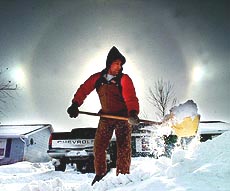
US blizzard claims 39 lives CHICAGO, Jan 4 (AFP) — At least 39 people died in the weekend blizzard that ripped through the mid-west and eastern USA, CNN reported early today. Most of the storm victims were killed in vehicle accidents, although some died in house fires, according to reports. Four people died near Lexington, Virginia in a highway accident involving eight tractor-trailer rigs and seven cars, CNN said. In Minnesota, sub-zero temperatures may have contributed to the deaths early on Friday of three adults and three children in a house fire in the town of Ceylon. Officials say the cause may have been a faulty heater. A 60-car pileup caused by icy roads was reported in the New York borough of Queens yesterday morning. Some 23 people were injured. Earlier in New Jersey, 30 people were injured in a 23-vehicle pileup near the town of Hackensack, CNN said. In Chicago, the blizzard dumped 55 cm of snow and is considered the second worst snowstorm in local history. Hundreds of thousands of travellers were stranded at airports across the US mid-west. The blizzard, which wreaked havoc in several states on Saturday, is one for the history books, according to meteorologists. In Iowa, one person died in a sledding accident, another in an apparent storm-related fall, and a third of a heart attack while shovelling snow. The powerful winter storm,
which has now moved east, also dumped mounds of snow in
Indiana, Iowa, Kentucky, Michigan, Minnesota, Missouri,
Nebraska, Ohio and Wisconsin. |
$ 110 b hike in US defence budget WASHINGTON, Jan 4 (PTI) — President Bill Clinton plans to increase the US defence budget by a whopping $ 110 billion over the next six years, the biggest such hike since the end of the cold war. Mr Clinton on Saturday unveiled the plan to drastically hike the outlay for a six-year expansion that “will represent the first long-term sustained rise in defence spending in a decade”, The Washington Post said. In his first weekly radio address of the year, Mr Clinton said he would ask the Congress to approve $ 110 billion to raise US “military readiness” to take on a role concomitant with its standing as the world’s sole superpower. Although the planned outlay falls much short of the $ 148 billion demanded by the Pentagon, the hike has left Clinton critics astounded and non-governmental organisations hoping for a “peace dividend” dismayed. “We must undertake this effort today so that our nation will remain strong and secure tomorrow,” Mr Clinton said in his address. Much of the funds will be used to fund joint exercises, flight training and buying spare parts. It would also pay for the “next generation of ships, planes and weapons systems” and would replace ageing equipment. But Clinton critics immediately slammed the move as reflective of a “lingering and inappropriate cold war mentality among military planners who believe it is imperative to buy and build even more sophisticated weapons.” Michael O’Hanlon, a defence expert at the Liberal Think Tank, the Brookings institution, pointed out that Russia and China, second behind the USA in defence spending, each spend only $ 50 billion a year on defence. Military spending in the USA far exceeds that of any other nation, critics said, and the technological gap between the USA and even that of its allies is growing alarmingly wide. “It doesn’t make sense to add billions for gold-plated weapon systems when nobody can keep up with us anyway. That (move to hike budget) is cold war thinking,” O’Hanlon said. Critics also questioned
the size and cost of the US strategic nuclear deterrent
that Clinton has said Washington needs to retain
indefinitely for first use against any country which
threatens US forces or its allies with any weapons of
mass destruction. |
Gangs rule the roost in Karachi THE police band swings into a tune that sounds suspiciously like wedding music, and the men stand just a little straighter for inspection: these are the last rites before the recruits pass out of an anti-terrorism course and into a city where there were nearly a 1,000 murders last year. In a viewing tent, TV monitors show the recruits patrolling streets and breaking down doors in a mock-up of a Karachi suburb. There is steady applause, but Hussain Asghar, police superintendent of Karachi’s most dangerous district, is unimpressed. “The guys we are trying to subdue are better trained than us. They have better brains than us,’’ he says. His mobile phone rings and he rises to leave. The recruits are graduating at a time when the Pakistani authorities are struggling for control of a city riven by political violence and crime gangs that feed off every pulse of economic life — even the supply of water and electricity to homes. In November Prime Minister Nawaz Sharif dismissed the Sindh state assembly for its failure to govern Karachi and accused his partners in the ruling coalition, the Muttahida Quami Movement (MQM), of orchestrating the violence. “There was total anarchy,’’ said Ikram Sehgal, who runs a private security agency. “The gangs were running riot. Anyone with a militant gang in his area was ruling the roost and the police were absolutely demoralised.’’ Mr Sharif also ordered the army to set up special courts to fast-track criminal trials — at first demanding verdicts within three days. The courts, open only to journalists who meet the army’s approval, delivered their first verdicts last month in death penalty cases. Murder, kidnappings, extortion and car-jackings have been part of Karachi’s metropolitan landscape for a decade: the ugly side of life in a city of 11.5 million that grew too fast, and gave its citizens too little. But in Karachi, discontent at the government’s failure to provide jobs, housing, transport, sanitation or even drinking water translated along ethnic lines, exploding in the MQM, which claims to represent Urdu-speaking migrants from India, the Mohajirs. The Mohajirs account for about a third of Karachi’s population. “The people from Punjab want to control Karachi. The establishment is Punjabi throughout Pakistan. Even in Karachi — they are overwhelmingly in police, they were overwhelmingly in the administration. They want to control the Mohajirs, but we don’t accept their ruling the city,’’ said Kunwar Khan Yunus, spokesman for the MQM. About 1,000 men have been arrested in the latest operation. More than half are MQM members, despite the rise of other armed militant groups in the city. But even MQM leaders say this crackdown has been far less brutal than previous ones. To many observers that equanimity suggests a quiet understanding between Mr Sharif and the MQM to allow the operation to go ahead so long as the police do not resort to widespread abuse. They say the MQM wants to be rid of the more thuggish elements in the party so it can return to political power. “Their high command
has told people not to resist —
unofficially,’’ Mr Asghar said. “It is a
kind of unspoken truth, as long as we do not arrest
innocent people or have extra-judicial executions, they
will not do anything.” But he admits it is difficult
to control his forces. ``Because of encounters in the
past, every member of the Sindh police is used to firing
and killing.’’ That in turn leaves the MQM to
decide how it will protest at the crackdown. —
The Guardian, London |
Kosovo rebels set up radio station PRISTINA (Yugoslavia), Jan 4 (AP) — In a move to reinforce their independent image, Kosovo’s ethnic Albanian rebels have announced that they are establishing a new radio station and news agency to promote their ideals. The Kosovo Liberation Army, in a statement yesterday to ethnic Albanian journalists, said the station would be known as “Kosovo E Lire,’’ or “Free Kosovo.’’ The news agency would be called “Kosovo Press.” The statement did not say when the station would begin broadcasting or where it would be based. No frequency was given. The move appeared aimed at distancing the rebels further from moderate ethnic Albanian leaders such as Ibrahim Rugova. Rugova’s party operates the Kosovo Information Centre, which disseminates news and information to foreign and ethnic Albanian journalists here. The KLA opposes Rugova’s nonviolent stand in the conflict with Serbia. The rebels have demanded independence from Serbia, the main republic of Yugoslavia. Rugova has expressed a
willingness to negotiate with the government on the
future of the province. But US-led efforts to bring the
two sides to the negotiating table have so far failed. |
Troops storm Aceh JAKARTA, Jan 4 (Reuters) — Thousands of Indonesian troops today clamped down on the rebellious province of Aceh after a weekend of violence in which the security forces shot dead nine civilians, witnesses and the police said. Troops yesterday opened fire on a mob of thousands which was attacking government buildings in an area near the industrial town of Lhokseumawe. “Nine civilians were
shot, 23 suffered heavy injuries and we have detained 123
persons,” northern Aceh police chief Colonel
Iskander Hasan told reporters in Lhokseumawe yesterday. |
| H |
|
||
| Mars spacecraft lifts off WASHINGTON: The US Kars Polar Lander probe has lifted off from the Kennedy Space Centre at Cape Canaveral, Florida, hurtling towards a rendezvous with the red planet. Nasa officials said the Delta-II rocket carrying the probe took off successfully on Sunday on the schedule. The Lander is expected to touch down on Mars on December 3, 1999, shortly after releasing Deep Space 2, a set of two mini-probes that will imbed itself into the Martian soil. — AFP Lebanese targets hit Second Pak
execution New Peru PM Pinochet trial Chinese dissidents Bun record broken |
 |
 |
| Nation
| Punjab | Haryana | Himachal Pradesh | Jammu & Kashmir | | Chandigarh | Editorial | Business | Sport | | Mailbag | Spotlight | 50 years of Independence | Weather | | Search | Subscribe | Archive | Suggestion | Home | E-mail | |