

Friday, October 15, 1999
 spotlight
today's calendar
 .......
 |
W O R L D | Friday, October 15, 1999 |
|
| weather spotlight today's calendar |
....... |
||
|
Benazir’s bid for safe
passage to Pak LONDON, Oct 14 — Benazir Bhutto, former Pakistani Prime Minister in self-imposed exile in Britain, is trying to contact military leaders to secure a safe passage home after Tuesday’s bloodless coup that ousted Premier Nawaz Sharif. Chechen
President not in control: Russia |
 |
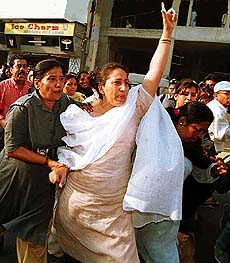 KARACHI: A supporter of deposed Prime Minister Nawaz Sharif is arrested on Thursday in the southern Pakistani city of Karachi. Sharif was dismissed from power in a military coup on Tuesday. 15 people were arrested during the demonstration. — AP/PTI |
|
800m
starve despite food surplus OAU
pioneer who tried to make Tanzania rich |
||||||
 |
|||||||
Benazir’s bid for safe passage to Pak LONDON, Oct 14 (PTI) — Benazir Bhutto, former Pakistani Prime Minister in self-imposed exile in Britain, is trying to contact military leaders to secure a safe passage home after Tuesday’s bloodless coup that ousted Premier Nawaz Sharif. Ms Bhutto, who could face arrest because of outstanding allegations against her from her time in power, told The Times that she wanted to help her country and was “trying to make arrangements to speak with the Chief of Staff on the phone because I need to resolve the question of my safety before returning to Pakistan”. She said she had a “good opinion” of Gen Pervez Musharraf, the Chief of Staff, who has seized power in Pakistan. “He was always courageous and a bold professional committed to civilian order,” Ms Bhutto said last night of General Musharraf, who was the Director-General of Military Operations during her tenure as Prime Minister. The Pakistan Peoples Party (PPP) chief called for free and fair elections within 90 days and appealed to President Rafiq Tarar to resign. The son of ousted Pakistani Prime Minister Nawaz Sharif had said he is concerned for the safety of his father. Hasan Sharif, a student in Britain, on Wednesday told the BBC’s Newsnight programme that he had been unable to speak to his father or members of his immediate family since the military ousted the Pakistani government on Tuesday. “I was told that he was taken to a guest house which they say is close to Islamabad airport and since then I have had no idea whatsoever where my father is and how he is being treated”, Hasan said. ISLAMABAD (Reuters): Pakistan’s media quackly turned against Mr Sharif on Thursday, saying his dictatorial actions forced the Army to step in and dismiss his government. The independent newspapers, which has spoken out against Mr Sharif’s government in the run-up to Tuesday bloodless coup, said the overthrow by the Army was justified because Mr Sharif had become too powerful and undemocratic. The Nation criticised Mr Sharif for being power hungry and for his attacks on the judiciary and for forcing a Chief Justice to resign last year. Meanwhile, Pakistan’s former President Farooq Leghari on Thursday called for a caretaker government that should “cleanse” the country of corruption and hold elections. OTTAWA: Canada has said that it hopes Pakistan’s new military rulers would bow to pressure from the commonwealth and take immediate steps to restore the country’s civilian government. Foreign Minister Lloyd Axworthy also said there would be no question of Canada cutting humanitarian aid in the wake of Tuesday’s coup, which ousted the 31-month-old government of Mr Sharif. Ministers from the Commonwealth, mainly former British colonies, will hold a meeting in London on Monday that looks likely to recommend Pakistan be suspended from the organisation. US issues travel advisory on Pak WASHINGTON, Oct 14 (PTI) — The USA today issued a travel advisory urging its citizens to remain in their residence in Pakistan in view of the Army coup in that country. “While there have
been no confirmed instances of violence, the situation
remains fluid.We urge American citizens to exercise some
caution. In particular, we are recommending that
Americans’ remain in their residences and avoid
unnecessary movements outside their residences.” |
Chechen President not in control: Russia MOSCOW, Oct 14 (UNI) — Russia has said Chechen President Aslan Maskhadov has lost control of the breakaway republic to the Islamic militants, who are now indulging in systematic extermination of the local population so as to mobilise aid and assistance from the European Union which could then be used to earn hard cash drug laundering, Kremlin sources have said. Referring to the prevailing situation in Chechnya, Russian Minister for Ethnic Relations Vyachslav Mikhailov, said the extremists were the real rulers in the land-locked country and that Mr Maskhadov had lost control over its territory, Voice of Russia reports. “The breakaway republic has become the refugee centre for the national and foreign terrorists,” he said. Voice of Russia reports that Kremlin apprehends Chechen rebel assaults on the nuclear establishments in Russia and is in possession of information that the Chechen rebels after the fiasco of their plans to run over the Daghestan province of Russia have formed suicide squads to carry out assaults on various targets, inside Russia, including women. Referring to the Chechen Government’s offer to open negotiations between the sides, Prime Minister Vladimir Putin, reiterated “first things first. The Chechen Government must round up the militants and the mercenaries operation on its land and hand them over, to Kremlin.” He drew Chechen President’s attention to the threat of Shamil Basayev, who he appointed Commander of the Chechen Eastern Front, who to largely spoke of his troops plans to carry out subversive actions on Russian soil. Meanwhile, the Kremlin has refuted the reports circulating here on Russian President Boris Yeltsin transferring powers to Prime Minister Vladimir Putin following the President’s hospitalisation with flu. Russian media quoting
official sources said Mr Yeltsin was proceeding on leave
to take rest and will return to work by the end of
October. |
Window on Pakistan Imagine the imposition of military rule in a democracy and the people dancing to the bhangra tunes in the streets. This is what has been happening in Lahore and Karachi for the past two days. The Opposition’s happiness at the ouster of Pakistan Prime Minister Nawaz Sharif and the dismissal of the provincial governments is understandable, but people joining the celebrations when the future is so uncertain is some comment on the way Mr Sharif ruled the hapless country. He had romped to power in March, 1997, with a massive mandate on the promise of development and peace with India. And then he just went on to waste this opportunity. Interestingly, not many Pakistani newspapers are critical of the military take-over. The Press in Pakistan has a great tradition, though it often indulges in India-bashing. But then Pakistan’s mainline newspapers, both English and Urdu had either ignored or played down the warning of an impending military coup. The warning had been emanating from local reliable sources and then there was a public warning from the USA, that trusted ally of the successive Pakistani governments, particularly the ones lead by army dictators like Gen Yahya Khan or Gen Zia-ul-Haq. The attitude was: “Thy neighbour is watching, play down the crisis.” Many well-known commentators fell victim to the national chauvinism. Nevertheless the warnings were discussed and each one prayed for wisdom and long life. The Friday Times, Newsline and Herald did not mince words. Even The Pakistan Times in its editorial, “Beware of the conspiracies”, admitted the fragile nature of Pakistan’s democracy and the other dangers that lie in that. Some newspapers had letters from well-informed readers saying that everything in Pakistan should not be happening with an eye on Kashmir or the relationship with India. “There is much to learn from each other, much to exchange and much to appreciate”, some letters argued. But The Pakistan Times editorial carried on September 26 did call a spade a spade when it found that democracy was a shambles. The editorial said, “It is sad to note that democracy could not take roots in the country despite the lapse of more than five decades as is evident from the latest series of clarifications issued one after the other by army and government spokesmen. What made them offer these explanations is in itself a slur on the face of democracy. Are our democratically elected regimes particularly those established on the basis of heavy public mandate still facing the danger of toppling in the midst of their tenures by armed forces? “If that is the case, then certainly democracy is a shambles. If that is not the case and rumours are being spread by design by certain quarters, even then it presents a bleak picture of democracy in Pakistan” The Pakistan Times said, “It’s time that all the institutions take a firm, unified stand on this delicate issue. Their representatives should sit together and deliberate seriously to redefine their parameters that some of them have transgressed in blatant violation of the Constitution and its spirit that stood in conformity with the vision of our forefathers.” It went on to say, “Things are pointing out towards a conspiracy that has been hatched at external and internal levels by certain destabilising elements, their first step in the direction of achieving their targets being the projection of imaginary rifts among our national institutions.” “It is the bounden duty of all of us individually and collectively to safeguard the country and democracy against these odds and conspiracies lest they entrap us into the worst kind of disaster that we might never be able to contain,” it urged. But as someone asked would the army take-over offer any lasting solution. The answer is a big no. How long can people live on the diet of fundamentalism, Talibisation and hate India? Many serious thinkers in that country, cutting across political affiliations, have been warning against this overdose of “junoon” and asking to concentrate more on economic, social and political justice. No one among the rulers seemed to be listening and the inevitable has happened. The huge mandate that democracy gave to Mr Nawaz Sharif in 1997 has been wasted. — Gobind
Thukral |
800m starve despite food surplus LONDON, Oct 14 (Reuters) — Almost 800 million people in the developing world are short of food despite a planet-wide surplus, the United Nations said today. "This state of affairs is unacceptable," the U.N.’s Food and Agriculture Organisation said in a report. Farmers grow on an average 2,700 calories worth of food for every person, more than enough, Dr Hartwig De Haen, the FAO’s Assistant Director-General of Economic and Social Development, said at a briefing in London. "In terms of energy (calories) there would be enough," he said. But it was unrealistic to see fair distribution as an answer to the world’s food problems. "Equal distribution is a totally hypothetical idea which will never be achieved," he said. Instead, governments should try to create the conditions needed to prevent food shortages, particularly political stability and economic growth. In the report the FAO
made the first estimate of the number of undernourished
people in the developed countries. It gave a figure of
around 34 million, made up of 26 million in eastern
Europe and the former Soviet Union and eight million in
the industrialised countries. |
OAU pioneer who tried to
make Tanzania rich DAR ES SALAAM, Oct 14 (Reuters) — Former Tanzanian President Julius Nyerere, who died in London today aged 77, was one of Africa’s most revered post-colonial leaders, although his attempt to build a socialist society ended in failure and impoverished his country. Nyerere paved the way for his bold experiment by leading Tanganyika to independence from Britain in 1961 before becoming its first President in 1962 and masterminding its union with the island of Zanzibar in 1964. His 1967 Arusha declaration proclaimed socialism and self-reliance as Tanzania’s twin goals and set the stage for sweeping nationalisation and a controversial attempt to group scattered peasant families in “Ujamaa” co-operative villages. The scheme produced major benefits in education and health care, but Nyerere’s social achievements were overshadowed by the absolute failure of his economic policies. When he stepped down as President of Tanzania in 1985, he confessed that he had failed to improve the agriculture-based economy of the impoverished country of 30 million people, a rare admission on a continent where few politicians admit any fault. Popularly known as Mwalimu — Swahili for teacher — and usually dressed in a Mao-style safari suit, he earned respect for his integrity and intellect but was accused by critics of turning a potentially rich country into one of Africa’s poorest. Tanzania’s economic crises and the reluctance of western donors to continue funding aid projects which they felt were being undermined by government policies led Nyerere to open talks with the International Monetary Fund (IMF) in 1980. He baulked at demands for massive devaluation and easing of rigid controls on the economy and left his hand-picked successor Ali Hassan Mwinyi to decide whether to accept the IMF terms. After his retirement, Nyerere played an advisory role in both Tanzanian politics and broader African affairs. For the last four years of his life, he mediated in peace talks aimed at ending civil war in neighbouring Burundi. Nyerere’s successes were in the international arena, where he championed African liberation from colonial western rulers. He was a strong opponent of South Africa’s white minority rule and pushed for economic and political measures against the government’s apartheid policies. As a major force behind the pan-African movement and one of the founders of the Organisation of African Unity (OAU) in 1963, Nyerere was a key figure in African events in the seventies when Tanzania became a magnet for anti-colonial activists and radical intellectuals. But his role in Africa was often controversial. In 1967, he recognised secessionist Biafra, crushed three years later in Nigeria’s civil war. In 1979, he rejected the principle of non-interference in the internal affairs of OAU member states and sent the Tanzanian army to end Idi Amin’s brutal dictatorship in Uganda. Julius Kambarage Nyerere was born on April 13, 1922 at Butiama, a small village near Lake Victoria. The son of chief Nyerere Burite of the Wazanaki tribe, he attended a government school from the age of 12 and then went to a mission school, where he became a devout Roman Catholic. Nyerere took a teacher’s diploma at Makerere College in Uganda and in 1948 won a scholarship to Edinburgh University in Scotland to study history, politics and law. He became the first black graduate in British-administered Tanganyika and in 1954 formed the Tanganyika African National Union — the forerunner of the ruling Chama Cha Mapinduzi now led by President Benjamin Mkapa — to campaign for independence. Nyerere is survived by
his wife Marie, whom he married in 1953, and their eight
children. |
| H |
|
||
| Suharto’s son acquitted JAKARTA: An Indonesian district court on Thursday acquitted a son of former President Suharto, Hutomo “Tommy’’ Mandalaputra, of corruption charges in a land swap deal. “The defendant has been clearly proven not guilty of corruption charges,’’ Mr R. Suharto, presiding judge of the South Jakarta district court, said. The judge said seven witnesses during the trial had retracted statements they had earlier given the state attorney’s office. — DPA Accord on prisoners 7 prisoners
killed Anti-Nazi League
stir |
 |
 |
| Nation
| Punjab | Haryana | Himachal Pradesh | Jammu & Kashmir | | Chandigarh | Editorial | Business | Sport | | Mailbag | Spotlight | 50 years of Independence | Weather | | Search | Subscribe | Archive | Suggestion | Home | E-mail | |
















