Friday, December 3, 1999
|
N A T I O N |
|
weather  spotlight spotlighttoday's calendar |
 |
 |
|
|
Almatti case for larger Bench NEW DELHI, Dec 2 — The Supreme Court today referred the dispute between Karnataka, Andhra Pradesh and Maharashtra over the raising of the height of the Almatti Dam beyond 509 metres along with other contentious issues relating to the sharing of Krishna river water to a Constitution Bench. No-trust move against Basu
defeated |
|
|
‘Circumstantial evidence must be complete’ NEW DELHI, Dec 2 — The Supreme Court has ruled that in a criminal case based solely on circumstantial evidence, the evidence should form a chain pointing towards the guilt of the accused to convict him. DMK for
quota in judiciary
Contract
for purchase of Bofors spares Ministry
approves medicinal plant board Contractors’
defiance invites SC’s ire ‘Sikhs
can visit Pak gurdwaras’ One
army man 'missing' in Kargil war CPM
man killed, stir hits life in Kerala BSF
probe blames sentries Supercomputer
for Russia India,
China agree to settle border issue Indigenous
MPV trial in Dec Fernandes:
2000 Pak ultras in J&K |
||||||
  |
|||||||
Almatti case for larger Bench NEW DELHI, Dec 2 (PTI) — The Supreme Court today referred the dispute between Karnataka, Andhra Pradesh and Maharashtra over the raising of the height of the Almatti Dam beyond 509 metres along with other contentious issues relating to the sharing of Krishna river water to a Constitution Bench. A three-Judge Bench headed by Mr Justice S.B. Majmudar, after hearing arguments briefly, transferred the applications to a larger Bench, saying any order passed on these would have an impact on the original suits on the river water dispute already placed before the Constitution Bench. "We observe that the dispute between the contesting states deserves to be heard at the earliest," the Bench said and fixed January, 2000, for the hearing to commence. Karnataka counsel, Fali S. Nariman, contended that the state had not been able to utilise its share of around 700 tmc feet of Krishna river water awarded by the Bachawat Tribunal almost 20 years ago and said there was an urgent need for the dam height to be raised to at least 519 metres, as has been conceded by an expert committee. However, Andhra Pradesh counsel K. Parasaran said that the Central Water Commission has approved the dam height of only 512 metres and there has been no clearance from either this technical committee, Central Electricity Commissioner or the Environment Authority. Maharashtra said it opposed raising of the dam height to 524 metres, as sought by Karnataka, since a large tract of the state would be inundated. The Constitution Bench would also decide whether the court had jurisdiction to entertain matters relating to such disputes after the express ban provided under Section 11 of the Inter State River Waters Disputes Act. Karnataka had placed 26 crest gates without skin plates, used to arrest the flow of water, on the Almatti Dam, making provision for raising the effective height of the dam to 524 metres at a short notice of three months. Nariman said the Bachawat Tribunal under Scheme A had said the Almatti Dam could utilise 160 tmc feet water but at the present height of 509 metres, it could store only 23 tmc feet of water. He said if the height could be allowed up to 515.2 metres the storage capacity could go up to 48 tmc feet. A scheme for division of surplus water was made but it has not been implemented at all and Andhra Pradesh was taking the whole 330 tmc feet of surplus water. Andhra Pradesh through Parasaran contended that Karnataka has been able to garner the maximum benefit from the court by taking a piece-meal approach. He said the state has been seeking a proper solution to the problem since 1997, but every time Karnataka had refused to heed it, terming it as unimportant and suddenly prefer to come to the court citing grave importance of the matter. The Bachawat Tribunal
award, ironically, is open for review by the contesting
states after May, 2000, but its original Award is yet to
be implemented fully, Nariman said. |
No-trust move against Basu defeated CALCUTTA, Dec 2 (UNI) — The Congress-sponsored no-confidence motion against the Jyoti Basu government was today defeated by 148-61 votes in the West Bengal Assembly. Earlier, participating in the debate, Mr Basu ridiculed the opposition parties, saying that they had no self-respect and have lost all moralities. ‘‘These opposition members do not have any character or any self-respect. They can join hands with any party for narrow gains,’’ he said. Mr Basu said many of the Congress members had joined hands with the BJP and were trying to dislodge his government. "If you think you can join hands with the BJP, RSS and Viswa Hindu Parishad and defeat us in the next election, I accept your challenge. For the people will not only reject you but throw you out,’’ he said. He regretted that it had become the habit of the opposition parties to move a no-confidence motion in each and every session of the house. ‘‘I hate to answer the allegations levelled by them as they don’t have any self-respect or any character,’’ he added. The Deputy Chief Minister, Mr Buddhadev Bhattacharjee, reiterated that the state had been holding the number one position in the country so far as law and order and the climate for industrialisation were concerned. He said the Left Front government had ensured stability in the state. "We know some people are making mistakes and voting for opposition parties. We will convince them and regain their confidence," he added. Earlier, moving the motion, the Congress deputy leader, Mr Saugata Ray lashed out at the state government for the deteriorating law and order situation, a depleting health care system and growing unemployment. The leader of the
Opposition, Mr Atish Sinha, alleged that the Chief
Minister had been trying frantically for a retirement
because he was frustrated with the performance of his
government. He also accused the Left Front of infighting
and said the people had become the victims of differences
among the ministers. |
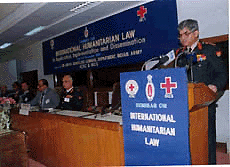
Malik: Army upholding humanitarian laws NEW DELHI, Dec 2 (PTI) — Army Chief General V. P. Malik today said that the Indian Army demonstrated its commitment to humanitarian laws by giving a decent burial to “disowned” Pakistani soldiers during the Kargil conflict despite mutilation of bodies of Indian troops by Pakistani Army. “Our adversary (Pakistan) indulged in torturing and cold bloodedly murdering some of our soldiers taken prisoners... still we demonstrated our commitment to the humanitarian laws by giving dignified and decent burial to their disowned soldiers,” he said in his inaugural address at a seminar on international humanitarian law (IHL) here. The seminar, marking IHL’s golden jubilee, is being jointly organised by the Judge Advocate General (jag) of the Army, International Committee of the Red Cross (ICRC) and the Indian Red Cross Society (IRCS). The Indian Army takes great pride in abiding by the four conventions — on amelioration of the condition of the wounded and sick in armed forces in the field, and of the wounded, sick and shipwrecked members of the armed forces at sea, on the treatment of prisoners of war and on the protection of civilians in time of war, General Malik said. He said the concept of humanitarian laws was part of Indian heritage and culture. The relevance of the Geneva Convention on international humanitarian law in conflict situations and making it more responsive to changing global realities would come up for discussion at the seminar. General Malik said, however, the implementation of the IHL had become a “one-sided” affair in the present era of proxy wars, trans-border terrorism and insurgencies perpetrated with a “design”. “In such conflicts soldiers have to face situations when they are confronted from religious places and even hospitals for which they have been trained not to harm,” he said. He said these lacunae and problems needed serious consideration as “there is no one to protect the human rights of a soldier, who is a civilian first and a soldier later.” He said even under the
present scenario the Army was maintaining the highest
tradition of human values by following the Geneva
Convention in letter and spirit despite provocations by
its adversaries. |
‘Circumstantial evidence must be complete’ NEW DELHI, Dec 2 (PTI) — The Supreme Court has ruled that in a criminal case based solely on circumstantial evidence, the evidence should form a chain pointing towards the guilt of the accused to convict him. A three-judge Bench comprising Justice G. B. Pattanaik, Justice M. Srinivasan and Justice S. N. Phukan, while acquitting the two accused in a murder case, said “when a case rests on circumstantial evidence, such evidence must be cogently and firmly established. “These circumstances should form a chain pointing towards the guilt of the accused and the same should be so complete that there is no escape from the conclusion that within all human probability the crime was committed by the accused and none else,” Justice Phukan said writing the judgement for the Bench. The case related to the murder of a taxi driver Balan in Kerala in March 1991. The accused allegedly hired the car and then strangulated him after intoxicating him while proceeding from Koyilandy to Wynad. The accused had changed the registration number of the car but a mechanic, to whom they had given it for repair, on detecting the change informed the police leading to their arrest. The prosecution, in the absence of direct evidence, had tried to prove the case through circumstantial evidence. The trial court had acquitted the accused but the high court had reversed that order. The first missing link in the chain of circumstantial evidence was the medical report which scotched the prosecution story that the driver was intoxicated by giving him fruit drinks mixed with sleeping pills, the Supreme Court said. The trial court also pointed out several discrepancies in the evidence collected by the investigating officer on which the apex court laid emphasis. The post-mortem report contradicted the prosecution story that the deceased was strangulated. The doctor who conducted the autopsy stated that he did not find any positive evidence of ligature strangulation. “In view of the missing links in the chain of circumstances we hold that the prosecution has failed to establish the guilt of the accused cogently and firmly,” Justice Phukan said. He said a reasonable
person on the facts of this case could not come to the
conclusion that the accused were guilty. |
DMK for quota in judiciary CHENNAI, Dec 2 (PTI) — The DMK, a partner of the BJP-led government at the Centre, today said it favoured caste-based reservation in judicial appointments and called for a national consensus on the issue. "The DMK is for extending reservation to backward classes and Dalits in the appointment of judges to High Courts. But it should be done after discussions at all-India level", the Tamil Nadu Chief Minister, Mr M. Karunanidhi, told reporters here. Asked whether he would extend support to an agitation to be launched by the Pattali Makkal Katchi (PMK) leader, Dr S. Ramadoss, demanding extension of reservation in judiciary, Mr Karunanidhi said he endorsed the PMK’s demand. "However, extending support to the agitation is an altogether different issue", he said. Earlier, Chief Ministers were consulted on the appointment of judges, but now the Chief Justice of India made the appointment after going through a list of names recommended by the Chief Justices of High Courts, he said. On the demand by some organisations for clemency to the four condemned prisoners in the Rajiv Gandhi assassination case, the CM said he had already told leaders who met him on the issue that he would do whatever was possible. On the recent Madras High Court judgement invalidating the Tamil Nadu Governor’s order rejecting the mercy petitions of Nalini, Murugan, Perarivalan and Santhan, on the ground that it had been done without the advice of the state Cabinet, Mr Karunanidhi said legal experts were studying the judgement in detail for further course of action. He said he could not say whether the Cabinet would meet to advise the Governor on the mercy petitions. On the conviction of a former AIADMK Minister, Mr Nagoor Meeran, by a special court in a wealth case today, Mr Karunanidhi said he did not want to comment on it. It would be improper on his part to say anything at present as a number of cases against many AIADMK ministers were pending before the special courts, he said. Asked whether there was
any bar on the convicted minister for contesting
elections for six years, he said he had been told by
legal experts that there was such a provision. |
3-yr RI for ex-TN minister CHENNAI, Dec 2 (UNI) — Former AIADMK minister Nagoor Meeran and his wife Noor Jameela were today convicted in the Rs 33.72-lakh disproportionate wealth case by the special court trying corruption cases against the previous Jayalalitha government. Special Judge S. Sambandam sentenced them to three years’ rigorous imprisonment, besides a fine of Rs 10,000 each. Among the 46 corruption cases against AIDMK General Secretary and former Tamil Nadu Chief Minister J. Jayalalitha, some of her erstwhile ministerial colleagues and close associates, this was the first case in which the accused had been convicted. However, the judge suspended the operation of the sentence till January 27 next, allowing the petition filed on behalf of Nagoor Meeran, under Section 333 (3) Cr PC to enable him to file an appeal against the order, on the condition that the accused should execute a bond for Rs 25,000 each, without sureties. This is the second judgement delivered by one of the three special judges, appointed by the Tamil Nadu Government by a G.O. dated April 30, 1997, to try cases of corruption against Ms Jayalalitha, her erstwhile Cabinet colleagues and IAS and IPS officials. This is the first verdict among the disproportionate assets cases pending against Ms Jayalalitha and others. Special judge-2, V. Radhakrishnan, had acquitted suspended IPS official E. Hariharne and Ziauddin of Nizars and Company last week in the fire tender scam. Mr Meeran as a Tourism Minister had amassed wealth in his name and in the name of his wife to the tune of Rs 33.72 lakh, disproportionate to his known sources of income. Hence, he was liable to be punished under relevant Sections of the IPC and the Prevention of Corruption Act. The prosecution said the properties allegedly purchased by them included houses, one of which was situated in Kottivakkam. The prosecution examined
51 witnesses. The prosecution admittedly had prepared to
examine over 1,800 defence witnesses in connection with
the gifts given to Mr Meeran during his marriage. It was
restricted to 245. Subsequently, this was reduced further
following a direction by the special court, later
confirmed by the high court and finally 33 witnesses were
examined. |
Contract for purchase of Bofors spares NEW DELHI, Dec 2 (UNI) — The government has signed certain contracts with Swedish firm Celcius, successor company of M/s AB Bofors, for the procurement of spare parts for the Bofors gun systems, Defence Minister George Fernandes informed the Lok Sabha today. In a written reply, Mr Fernandes said without prejudice to the ongoing investigations into the Bofors gun deal, the contracts had been signed subsequent to the lifting of the embargo, placed on the transactions with the then Ab Bofors (now Celcius). “No similar decision, however, has been taken in regard to the Bofors guns so far,’’ he said. He said the Ministry had not invited any techno-commercial proposals from foreign firms for the procurement of 155 mm Howitzers for the Army. Minister of State for Defence Production and Supplies Harin Pathak said a licence agreement between the Ministry and esrtwhile AB Bofors (of which Celcius is the successor company) for the transfer of technology had been concluded in March, 1986. The agreement is effective up to March, 2001, subject to further extension by mutual agreement. US ship: In reply to a question on the objective of the US research ship “Ron Brown” seen moving into the Bay of Bengal in north-east Indian Ocean in May, 1999, he said the vessel was gathering ocean and atmospheric data in the Indian Ocean region and throughout it had stayed outside the exclusive economic zone (Eez) (beyond 200 nautical miles from the Indian coast line. Peacekeeping operations: The Army has participated in 29 UN peacekeeping missions since Independence with the participation of 50,000 troops. Till date, 91 personnel have died while serving in these missions. Nishant:
The last test flight of Nishant, unmanned air vehicle,
was conducted by the Defence Research and Development
Organisation in March at Kolar. Nishant is designed to be
a battlefield surveillance unmanned aerial vehicle (UAV)
with a flight endurance of four and half hours at a speed
of about 150 km per hour. The system is designed to carry
electronic imaging sensors, photographic film camera and
other electronic mission equipment. |
Ministry approves medicinal plant
board NEW DELHI, Dec 2 — The Ministry of Health and Family Welfare has approved a proposal on the setting up a medicinal plant board, Minister of State for Health and Family Welfare, N.T. Shanmugam said here on Thursday. In his inaugural address at a two-day meet of State Secretaries and directors of Indian System of Medicine and Homoepathy (ISM&H), Mr Shanmugam said that the objective of the board was to promote conservation, cultivation and propagation of medicinal plants to facilitate availability of raw-materials to meet domestic and export needs. The Minister observed that there had been enormous growth in the utilisation of plant-based drugs and alternative systems of health care all over the world during the last 10 years. He said that the Indian agro-climatic diversity had all natural resources which could help in the cultivation and propagation of medicinal plants. Mr Shanmuagm said that a new Ayurveda rasayana programme was being formulated to be introduced as a pilot programme through the State ISM&H departments. He said that Ayurveda and Unani medicine particularly Yoga had a lot to offer to counter ageing process. He appreciated the efforts of the Himachal Pradesh and Kerala governments for promoting Indian systems of medicine by setting up 100 Ayurveda dispensaries in the respective states. He said that the medicines and therapies of ISM&H were time-tested, safe and cost-effective. He added that the Department of Family Welfare in the ministry had accepted some drugs of ISM&H for distribution to primary health centres. These drugs would be distributed to women and children through the ancillary nurse midwives (ANMs). He said that he had also directed that all regional laboratories processing the requisite infrastructure be recognised under the Drugs and Cosmetic Act for giving a special certificate to ISM&H drugs. The Minister said that the manufacturers would be encouraged to send the product for testing which would boost the sale of products and increase public receptivity. The department has also undertaken the work of finalising pharmacopeial standards for ISM&H drugs. He said that the documentation of traditional medical knowledge pertaining to Ayurveda, Siddha and Unani system to prevent patenting had been initiated by the department of ISM&H. He said that information on 50 most important plants used in ISM&H would be ready in three months thus placing the information in public domain. Mr Shanmugam said that the Department of Health and Family Welfare was supporting an ambitious scheme of creating Vanspati gardens in each state. Secretary, Family Welfare, A.R. Nanda said that inclusion of Ayurvedic and Unani drugs for expectant and lactating mothers as part of the drug kit being given to all primary health centres and sub-centres was under active consideration of the government. Secretary, ISM&H,
Mrs Shailaja Chandra said that for the first time,
guidelines had been issued to the States for accrediting
the institutions imparting Yoga training. She said that
the Central Council of Ayurvedic Drugs in consultation
with the Medical Council of India and the Indian Medical
Association was evolving a strategy to standardise
ISM&H drugs. She said that a report on this would be
submitted by an expert committee in three months and
accordingly a Bill would be introduced. |
Contractors’ defiance invites SC’s ire NEW DELHI, Dec 2 (UNI) — In a significant order, aimed at protecting a large number of stone-quarry labourers from exploitation by mine contractors in Haryana, the Supreme Court has asked the state government to consider cancellation of leases of those contractors who have been denying minimum wages to their workers. A bench comprising Mr Justice S. Saghir Ahmed, Mr Justice D.P. Mohapatra and Mr Justice R.P. Sethi also took strong exception to the continuing defiance of the court’s directives by a section of the contractors which, according to them amounted to gross violation of labour laws, including the Minimum Wages Act. Among others facing prosecution for denying minimum wages to the labourers is Haryana Minister Kartar Singh, whose mining company, Ram Shyam and Co. owes a straggering amount of Rs 31 lakh to the labourers. On a petition by the Badhua Mukti Morcha, alleging unabated exploitation of the labourers by some of the mine contractors in Haryana, the court also asked the Faridabad Chief Judicial Magistrate to file an affidavit giving details of the number of cases relating to the non-payment of minimum wages pending before him. The court asked the Central Labour Commissioner, Mr B.B. Bhatnagar to verify whether all nine respondent contractors were paying the minimum wages to the labourers. The judges noted the amicus curiae Ranjit Kumar’s statement that the non-payment of minimum wages amounted to “begar” which was an offence under Section 37-A of the Indian Penal Code. The illegal mining
activities had started with the present state government
permitting excavation of silica and sand in the vicinity
of Surajkund and Badhkal tourist complexes, despite a ban
already imposed by the apex court on any mining
activities in the area. |
‘Sikhs can visit Pak
gurdwaras’ NEW DELHI, Dec 2 — The Centre said today that it had not stopped individuals who were willing to visit Sikh shrines in Pakistan, while it took a serious note of the disrespect shown by Pakistan by appointing former ISI chief to head the Pakistan Gurdwara Parbandhak Committee (PGPC). The Union Home Ministry said today that while the SGPC had decided against sending “jathas” (delegations) of Sikh pilgrims in protest of the Pakistan’s decision on different religious occasions this year, the Centre had not stopped those who were willing to go in the individual capacity. “In view of the decision of the SGPC, there was no official jatha of Sikh pilgrims to Pakistan on (religious) occasions. At the same time, the Sikh pilgrims with valid passport and visa who were desirous of going to Pakistan in their individual capacity to visit holy gurdwaras were also not stopped from going to Pakistan”, an official spokesman of the ministry said today. The ministry said “the constitution of the committee headed by a Muslim, who has been a former chief of Pak-ISI is a “direct attack on the religious rights of the Sikh minority in Pakistan to manage their holy religious shrines”. It said the reactions to
the move was not just in India but Sikhs all over the
world were incensed. |
One army man 'missing' in Kargil war NEW DELHI, Dec 2 (PTI) — A total of 519 army personnel were killed and 1363 injured in the Kargil conflict, none taken prisoners of war while one was missing, Lok Sabha was informed today. In a written reply, Defence Minister George Fernandes said Rs 442.68 crore were collected up to November 22 by the National Defence Fund since May 1 while Rs 86.85 crore had been utilised for various purposes. A comprehensive welfare package has been provided to the next-of-kin of the armed forces personnel killed in the Kargil conflict as also for those invalidated out of service due to injury sustained in the Kargil operation, he said. In reply to another question, he said the IAF had during 1998-99 lost 44 aircraft in crashes. The Defence Ministry has accepted 55 of the 84 recommendations made by a high-powered committee of Fighter Aircraft Accidents (COFAA) constituted under the chairmanship of Scientific Adviser to the Defence minister which submitted its report in September, 1997, he said. The Minister said there
was no acute shortage of components for maintenance of
fighter planes and there was no aircraft known as special
auxiliary aeroplanes in the Indian Air Force. |
CPM man killed, stir hits life in Kerala THIRUVANANTHAPURAM, Dec 2 (PTI) — A CPM worker was stabbed to death allegedly by BJP-RSS workers in fresh outbreak of political violence as a 12-hour strike called by the BJP paralysed normal life across Kerala today. The latest killing takes the toll, in the spurt of political violence involving the CPM and the BJP-RSS in Kannur, since yesterday to four. Those done to death yesterday were two BJP men, including the leader of the party’s youth wing, and a CPM worker. Kanakan (34), stated to be a Marxist activist, was stabbed to death by a 12-member gang when he was going to visit his brother at Elankode in Kannur district, where two BJP men and a CPM activists were killed yesterday, the police said. About 200 BJP workers later blocked a police party from reaching the spot, resulting in police firing 12 rounds in the air. The attackers threw bombs at the police, causing injuries to eight police personnel. The strike, called by the BJP to protest the killing of its activists yesterday, was “near total” in all districts of the state, official sources here said. Buses kept off the road and attendance in offices was thin. Stoning of private vehicles that ventured out have been reported. Prohibitory orders had
been clamped in Kannur. |
BSF probe blames sentries NEW DELHI, Dec 2 (PTI) — The inquiry into the attack on the Border Security Force (BSF) residential campus in Bandipora in Jammu and Kashmir by militants on July 13 in which four persons, including DIG S.K. Chakraborty, were killed, has prima facie blamed the two sentries “who were missing from duty” on the day for the incident. The Staff Court of Inquiry (SCOI) has also held that only two militants were behind the sensational pre-dawn attack by suspected Lashkar-e-Toiba militants in which Chakraborty, Deputy Commandant Mahinder Raj, sub-inspector K. Bhaskaran and Bharati, wife of constable Munirajappa, were killed, BSF sources told PTI. The sources quoting the probe report said the two sentries on guard duty that day were “missing” which “enabled the militants easy access to the campus”. Once inside the premises, they first shot at Bharati, who had switched on the light to attend to her child, they said. Asked about the findings of the inquiry, BSF Director-General E.N. Rammohan said, “it will not be proper for me to comment as the inquiry process is still on. However, stern action will be taken against the guilty. The supervisory officers too will not be spared for their acts of omission”. The attack in the “high-security” premises had caused considerable embarrassment to the government and the BSF. The militants took 12 hostages, who were later rescued unharmed by crack commandos of the elite National Security Guards (NSG) in a dare-devil operation on July 14 morning. The sources said that only two militants had sneaked into the campus contrary to earlier belief that four to five ultras were behind the attack. Of the two militants
behind the attack, one was killed and one escaped under
cover of darkness, the report said. |
Supercomputer for Russia NEW DELHI, Dec 2 (UNI) — India is ready to send the latest version of the supercomputer Param-10000 to Russia to facilitate collaborative research in weather forecasting that would strengthen efforts to monitor movement of tropical cyclone systems in the future. The cost of the supercomputer is $ 1.5 million which is to be shared by both the countries. It is to enable Russia to open the state-of-the-art Institute of Computer Aided Design (ICAD) which would provide a world-class computing facility in Moscow for Indo-Russian research. Highly placed sources
told UNI here today that ICAD would be ready in three
months and that the supercomputer would reach Moscow
before it. The Pune-based prestigious Centre for Advance
Computing (CDAC) is supplying the computer. |
India, China agree to settle border issue NEW DELHI, Dec 2 (PTI) — India and China have agreed to seek a “fair, reasonable and mutually acceptable” settlement of the boundary issue through dialogue, the Lok Sabha was informed yesterday. The two sides, which have differences in perception of the Line of Actual Control in the border areas, including Arunachal Pradesh, are discussing the boundary question in the framework of the Joint Working Group, Defence Minister George Fernandes said in a written reply. They have expressed their commitment to respect the agreement on maintenance of peace and tranquillity along the Line of Actual Control in the India-China border areas (1993) and the agreement on confidence building measures in the military field along the Line of Actual Control in the Indo-China border areas (1996), he said. At present, there is no tension along the Indo-China border, he asked. About reports that China
had objected to creation of a new Indian Army unit to be
based in Leh, the Minister said Beijing had not raised
any such issue. |
Indigenous MPV trial in Dec NEW DELHI, Dec 2 (UNI) — The maiden trial run of the indigenously manufactured mine protected vehicle (MPV) will take place this month. Announcing this in the Lok Sabha during the question hour today, the Defence Minister Mr George Fernandes, said since such vehicles are not manufactured in India, the government had purchased 90 MPVs from South Africa in 1995 to meet the immediate need of the Army for counter intelligence operations. These vehicles are 11 to 18 years old. Therefore, they have been refurbished with overhauled engines. Sixty of them are deployed in Jammu and Kashmir and the North East. Replying to Mr Dilip Kumar Mansukhlal Gandhi, Mr Fernandes denied the allegation that the MPVs from South Africa were purchased at double the cost. In fact, the South African quotation was the lowest compared to the USA and the UK. He said two contracts
were signed with the South African firm M/s Reumech, for
procurement of 90 and 75 refurbished MPVs, along with
engineering support package thereof. |
Fernandes: 2000 Pak ultras in J&K NEW DELHI, Dec 2 (PTI) — An estimated 1200 to 2000 Pakistan sponsored foreign terrorists are operating in the border state of Jammu and Kashmir and there was no let up in the efforts of security forces to weed them out, the Defence Minister Mr George Fernandes informed the Lok Sabha today. Replying to a question in the House, the Minister said there had been no substantial change in Pakistan’s attitude after the Army coup in so far as the border situation was concerned as skirmishes were still taking place along the borders. Replying to a supplementary by the Congress leader, Mr Madhavrao Scindia, the Minister said some Army units were withdrawn from the valley to deploy them in Kargil. However, there was no withdrawal of Army from the Line of Control, (LoC) he added. Mr Fernandes disagreed with the member that the entire purpose of the Kargil intrusion was to divert India’s attention from anti-militancy operations and push in more infiltrators, saying the intrusion was aimed at occupying the entire Indian territory. The minister had angry
exchanges with Congress members when they wanted to know
why attacks on Army establishments had risen after the
Kargil intrusion. |
| H |
|
||
| TN Rajya Sabha member
dead CHENNAI: Thambi Venkata-chalam, a Rajya Sabha member from Tamil Nadu, died in the wee hours of Thursday at a hospital here, 10 days after he was critically injured in a car mishap, family sources said. He was 56. He is survived by wife, two daughters and a son. Venakatachalam belonged to the MGR Anna DMK, headed by former AIADMK Minister S. Thirunavukkarasu, now a BJP ally. — PTI Separate wing for AIDS
patients Bio-technology
park to be set up President to
open Ambedkar Bhavan 4 NSCN-IM men
arrested Flying club
coming up at Mangaon |
 |
 |
| Punjab
| Haryana | Himachal Pradesh | Jammu & Kashmir | Chandigarh | | Editorial | Business | Sport | | Mailbag | Spotlight | World | 50 years of Independence | Weather | | Search | Subscribe | Archive | Suggestion | Home | E-mail | |