







Over 200 youth show talent at dance festival


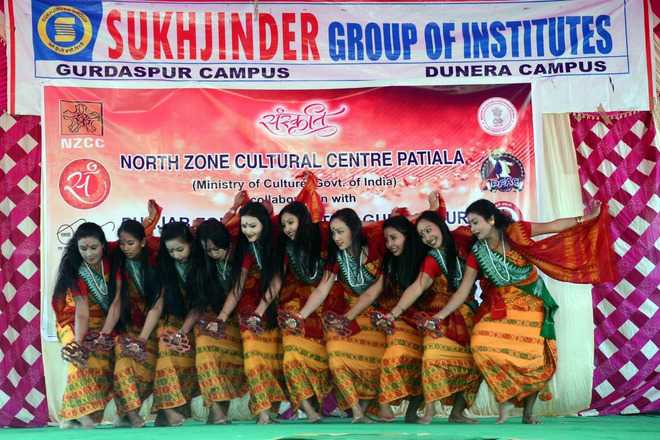
Tribune News Service
Gurdaspur, November 24
Around 200 dancers from eight states took part in the All India Lok Utsav folk dance festival which concluded at different venues here on Saturday. The participants were from Rajasthan, Assam, Odisha, Maharashtra, Chhattisgarh, J&K, Gujarat and Punjab.
Today was the last day of the festivities which were jointly organised by the Punjab Folk Arts Centre (PFAC), Gurdaspur, and the North Zone Cultural Centre, Patiala.
PFAC director Harmanpreet Singh said the event, financed by the Union Ministry of Culture, was organised under the National Cultural Exchange Programme.
Gurdaspur Deputy Commissioner (DC) Vipul Ujwal had lit the inaugural lamp on Tuesday.
“A nation’s culture resides in the hearts and souls of its people. We should lay emphasis on cultural activities which, in turn, will ensure that a state as well as a nation’s culture is preserved for the coming generations,” said Ujwal in his address.
The participants were lodged at the local Circuit House, which was refurbished by activists of the PFAC.
SSP Swarandeep Singh said tight security arrangements were put in place at different venues where the event was being held and also at the Circuit House.
The spotlight was on dancers of Assam who performed the famous Bardoi Sikhla folk dance. “It is an action-filled dance. Sometimes, girls even dance over burning embers,” said performer Upa Bala Mushahari.
The Chari dance of Rajasthan was much applauded by the audience.
“Chari is another ritualistic dance that primarily belongs to the Saini community of Ajmer and Gujjars of Kishangarh. Enacted by women, it is usually performed on special occasions such as the birth of a male child, marriage or festival. It symbolises joy as well as represents the ritual of collecting water in Chari which in Rajasthani language means a pot. Women are attired in traditional outfit and dance while balancing brass Charis on their heads, along with a lighted lamp in it. The dance is done to the sounds of the dholak and harmonium,” said Harmanpreet Singh.
Unlock Exclusive Insights with The Tribune Premium
Take your experience further with Premium access.
Thought-provoking Opinions, Expert Analysis, In-depth Insights and other Member Only Benefits
Already a Member? Sign In Now