









SMA Kazmi
Tribune News Service
Dehradun, November 20
The last session of the current Uttarakhand Assembly held at Gairsain in Chamoli district on November 17 and 18 remained contentious on the issue of declaring Gairsain as the permanent capital of the state.
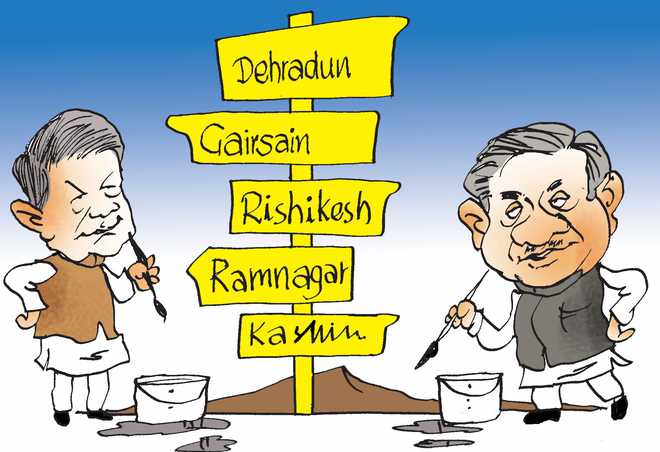
Interestingly, the Congress as well as the BJP are non-committal on the issue. While, the ruling Congress, led by Chief Minister Harish Rawat, has been trying to gain political advantage before the crucial state Assembly polls scheduled early next year by trying to project itself as the champion of sentiments of the people living in the hills, on the other hand, the BJP demanded that the ruling party declare Gairsain as capital without committing itself on the issue.
Keeping in view the emotional issue of declaring Gairsain as the permanent capital, both parties are non-committal on the issue. Both are trying to use it for political gains but afraid of coming out openly in support or opposition. These parties are afraid of backlash in the Terai region of the state if Gairsain is declared as the permanent capital. The Terai region would be the deciding factor in the Assembly polls as more people reside in the Terai region than in the hills.
Gairsain was envisaged as the state capital during the statehood agitation. However, after the formation of the state on November 9, 2000, Dehradun was made the temporary capital. The interim government, headed by Chief Minister Nityanand Swami, set up a commission headed by Justice (retd) Virender Dixit to find the suitability of a place for permanent capital in 2001. The commission submitted its report in 2008, after more than seven years, which was also placed before the state Assembly.
The commission looked into the feasibility of five places — Dehradun, Gairsain, Rishikesh, Kahipur and Ramnagar — as the state capital on several parameters, including geographic conditions, population, accessibility, transport system, proneness to earthquake or landslides and security. The commission found that Gairsain was less viable for the location of the permanent capital.
However, since the report did not suit the politicians as nobody wanted to go against Gairsain as the sentiments of the statehood agitators were involved, the report was not implemented.
The question of the permanent capital has been hanging fire since the formation of the state. It was former Chief Minister Vijay Bahuguna, who played the Gairsain card after the defeat of his son Saket Bahuguna in the Tehri Lok Sabha byelection in October 2012.
However, while he laid the foundation stone of the Assembly building in Gairsain in January 2013, he also laid the foundation stone of a new building of the Vidhan Sabha in Raipur in Dehradun in 2012.
After Harish Rawat took over the reins of the state in February 2014, he held a session of the state Assembly in a tent in summers that year. Since then, the state government had seven Assembly sessions in Gairsain.
Harish Rawat also seems to be trying to potray that his government would be sensitive towards the needs and aspirations of the people of the hilly region for whom the hill state was carved out of Uttar Pradesh. The situation in the hilly regions of the state did not change much in all these years rather it has worsened following the devastation caused by the natural disaster of June 2013. The rate of migration from rural and remote hilly areas has also increased owing to lack of basic civic amenities, health and educational facilities.
However, to take a decision in this regard would be difficult for any Chief Minister due to the hill-plain divide in the state. Even the legislators from plains and hills of these two main parties are divided on the issue.
It would be a difficult decision to declare Gairsain as the permanent capital of the state keeping in view the political realities.
Unlock Exclusive Insights with The Tribune Premium
Take your experience further with Premium access.
Thought-provoking Opinions, Expert Analysis, In-depth Insights and other Member Only Benefits
Already a Member? Sign In Now