









Satya Prakash
Tribune News Service
New Delhi, March 2
Maintaining that Punjab is a “very sensitive state”, the SAD-BJP government today asserted in the Supreme Court that the 2002 decree on the Sutlej-Yamuna Link (SYL) canal was not executable due to substantive decrease in availability of water and a variety of legal reasons.
Senior counsel RS Suri told a Bench headed by Justice PC Ghose that the 2004 Act passed by the state Assembly terminating the SYL canal water-sharing agreement with neighbouring states took away the very basis of the 2002 decree that went in favour of Haryana.
(Follow ; and )
He said the 2004 Act was never declared unconstitutional and so long as it was there, the 2002 decree could not be executed. He also pointed out that Haryana had not filed any petition under Article 131.
Suri said even the court’s verdict on the presidential reference was neither binding on the President, nor the states in question.
He said Punjab was forced to pass the 2004 Act because its water complaint filed in January 2003 was not acted upon and the Centre never set up a water tribunal to address its grievances.
The Bench, however, again clarified that it didn’t intend to revisit the facts and issues already adjudicated upon and asked the parties to spell out if the court’s verdict on the presidential reference was binding or not.
As Suri kept questioning the decree, Justice Ghose said: “To my mind, the decree which has been passed has to be executed.”
On behalf of the Haryana Government, senior counsel Shyam Divan contested Suri’s submission, saying it was fraught with serious consequences for the integrity of India. “If one state is forced to challenge the validity of a law passed by another state before the Supreme Court, then the Indian federation is not on a stable course,” Divan said.
Senior counsel Ram Jethmalani, who also represented Punjab, again requested the court to ask the Centre to try to mediate between the two states by bringing them to the negotiating table. As the arguments remained inconclusive, the Bench fixed March 28 for further hearing.
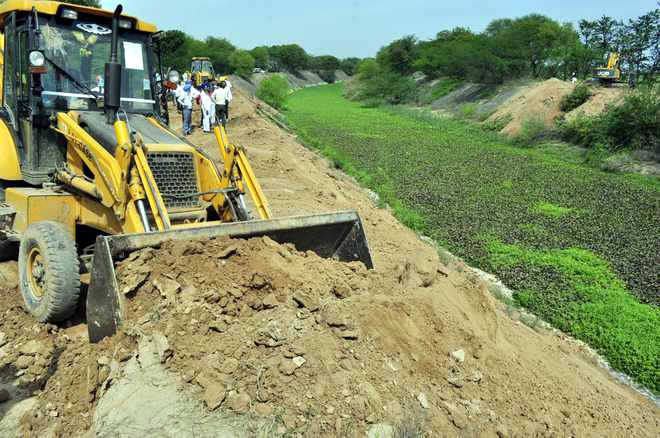
The top court had on February 22 made it clear that the SYL canal had to be constructed and both the state governments must maintain law and order. Punjab has maintained that the water-sharing agreement was signed in 1981 and the quantity of water flow had significantly decreased since then. Therefore, it wasn’t possible now to execute it.
But the Bench again today said: “We are at a stage where the decree has to be executed.”
The canal had to be constructed first. Whether the water was there or not or it’ll be there only in the rainy season or how much quantity was being maintained could be sorted out later, it had noted last month.
Unlock Exclusive Insights with The Tribune Premium
Take your experience further with Premium access.
Thought-provoking Opinions, Expert Analysis, In-depth Insights and other Member Only Benefits
Already a Member? Sign In Now