







‘Nehru’s Chandigarh’ comes to life in Delhi


Aditi Tandon
Tribune News Service
New Delhi, August 20
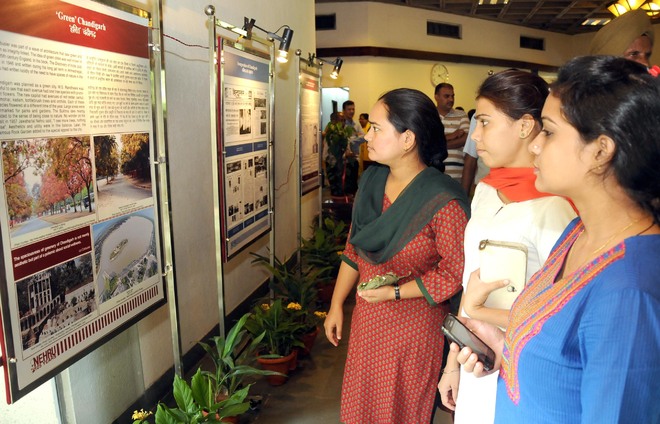
A unique exhibition on Chandigarh, mounted in the capital today by The Nehru Memorial Museum and Library, reveals little known facts about the making of the city and its evolution.
Part of the 125th birth anniversary celebrations of Pt Jawaharlal Nehru, the exhibition entitled, “The City of Hope”, weaves fine memories of Chandigarh’s past – of how Nehru felt the city would be a “soothing balm on the wounded spirit of Punjab” and how French architect Le Corbusier breathed life into Nehru’s dream of a modern city.
In his famous speech at Rajendra Park in Chandigarh on November 9, 1957, Nehru shared his vision of the city with its people, saying, “It was felt that to build a new city to be the capital of Punjab would give people something new to look forward to. We wanted them to look to the future with new hope after the trauma they had been through. We felt the new capital would be a symbol of new hope.”
A host of Nehru’s almost poetic quotes on Chandigarh are part of the exhibition which Lokesh Chandra, Chairman of the NMML inaugurated today in the presence of NMML Director Mahesh Rangarajan.
Montages in the show speak of interesting facts about the city’s conception, including how the first Commissioner of Chandigarh MS Randhawa ensured each of its avenues had one tree species with prominent flowers.
Accordingly, the capital at conception had avenues of red cedar, semul, gulhohar, kadam, bottlebrush trees and orchids. Each species flowered at a different time so the city wore a green drape round the year.
Randhawa’s thought was only an extension of Nehru’s vision of cities and of Corbusier’s obsession with spaces.
That Randhawa was successful in realising these visions was evident from Nehru’s exclamation during his November 1957 visit to Chandigarh: “I see more trees, nothing else.”
Another point the show makes about Chandigarh is – while Corbusier led its creation, there were others with him, both Indians and foreigners. His chief foreign associates were Pierre Jeannerette, Corbusier’s cousin in blood and profession, and British architects Edwin Maxwell Fry and his wife Jane Drew.
The show details how Corbusier struggled at that time to find Indian associates as India had only two schools of architecture and batches from both were yet to graduate.
Finally, PL Verma and PN Thapar were chosen by Corbusier who dedicated himself to Chandigarh from 1951 until his death in 1965.
The exhibition also reveals that Chandigarh was only one of the three new state capitals with origins in the years when Nehru was the Prime Minister. The other two were Gujarat’s capital Gandhinagar and Orissa’s capital Bhubaneshwar. Gandhinagar was planned by HK Mewada and Prakash Apte, both associates of Corbusier and Bhubaneshwar was designed by German architect Otto Konigsberger.
But Chandigarh was clearly the best city of its times, with Corbusier designing it like a work of art. On October 7, 1953, the day India’s first President Rajendra Prasad inaugurated the capital city of Punjab, Corbusier said, “A town is a mighty image that stirs our minds. Why should not the town be even today a source of poetry?”
Unlock Exclusive Insights with The Tribune Premium
Take your experience further with Premium access.
Thought-provoking Opinions, Expert Analysis, In-depth Insights and other Member Only Benefits
Already a Member? Sign In Now